

VNIT Nagpur Pioneers AI-Driven Traffic Innovations for Enhanced Road Safety
In a significant stride towards smarter urban mobility, researchers at the Visvesvaraya National Institute of Technology (VNIT) in Nagpur have developed four groundbreaking traffic solutions. These innovations leverage artificial intelligence (AI), machine learning (ML), and low-cost Internet of Things (IoT) devices to address critical challenges on Indian roads, aiming to boost safety and efficiency. The details were unveiled ahead of National Science Day on February 28, highlighting the potential of technology to transform traffic management.
Automated Helmet Detection System
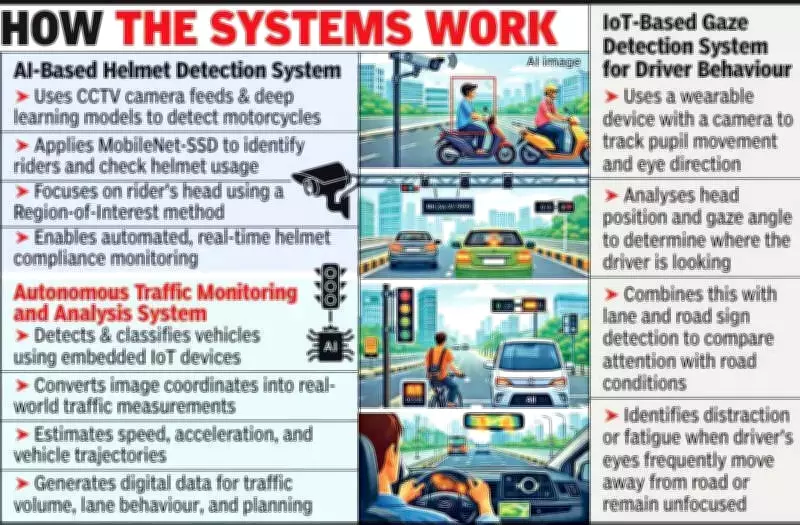
One of the key solutions is an automated system designed to identify whether two-wheeler riders are wearing helmets. Utilizing CCTV feeds and deep learning models, this technology employs pre-trained neural networks like MobileNet-SSD to detect motorcycles in traffic footage. A region-of-interest method then isolates the rider's head for helmet verification. Trained on over 3,400 images, the system has achieved approximately 79% testing accuracy. Researchers emphasize that this enables large-scale, real-time monitoring, assisting traffic police in consistent enforcement while reducing reliance on manual manpower.
IoT-Based Autonomous Traffic Monitoring System (ATMAS)
Another patented development is the IoT-based Autonomous Traffic Monitoring and Analysis System (ATMAS). Built on an embedded computing platform, ATMAS automatically detects and classifies vehicles, converts image coordinates into real-world coordinates, and estimates speed and acceleration profiles. It also extracts trajectory patterns and lane behavior data. Unlike traditional manual surveys, ATMAS continuously generates digital data on traffic volume, vehicle mix, and speed, which can be stored and uploaded to cloud servers. This reliable dataset supports authorities in optimizing signal timing, managing congestion, analyzing accidents, and designing roads scientifically.

Low-Cost Travel Time and Stream Speed Analyser
Addressing the need for affordable congestion monitoring, the third study introduces a low-cost Travel Time and Stream Speed Analyser. This system uses ESP32 microcontrollers with Bluetooth capability, with two compact devices installed at entry and exit points of a corridor. They capture anonymous Bluetooth MAC IDs within a limited range, and by matching IDs recorded at both points, the system estimates travel time and stream speed. Field trials showed a penetration rate of 12–13% and a match rate of 65%, with statistical validation confirming consistency with video-based measurements. The portable, energy-efficient device offers cities an economical way to monitor congestion in real time.
Wearable IoT-Based Gaze Detection System
The fourth study focuses on driver behavior through a wearable IoT-based gaze detection system. This device tracks pupil movement, gaze projection, and head pose, while integrating deep learning-based lane and road sign detection. Heat maps generated from the data reveal attention patterns and identify risky behaviors linked to distraction or fatigue. Tested on international datasets and Indian road conditions, including in Nagpur, the system has potential applications in driver monitoring, fatigue alerts, and advanced driver assistance systems.
Collective Impact and Future Prospects
Led by Udit Jain from the Department of Civil Engineering, these four studies collectively demonstrate how indigenous, low-cost technologies can support smarter enforcement, evidence-based planning, and improved road safety. They offer Indian cities a scalable path towards intelligent transportation systems, paving the way for more efficient and safer urban environments.






