

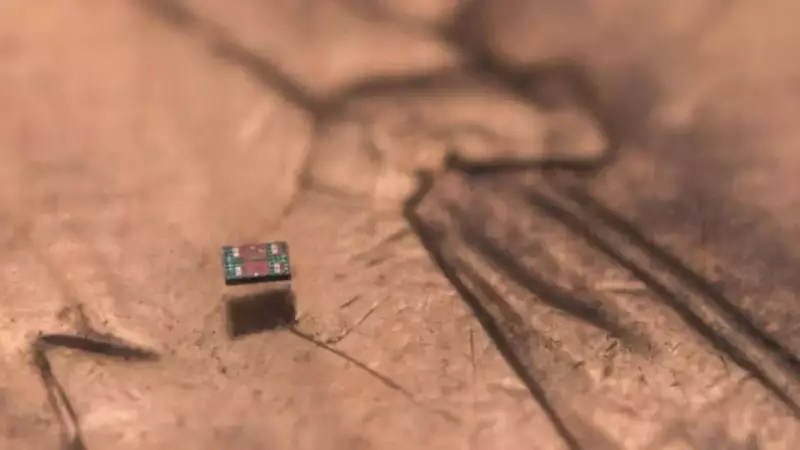
In a landmark achievement for robotics, a team of American researchers has successfully created the world's smallest, fully programmable, and autonomous robots. These devices are so minute they can sit on a human fingertip unnoticed, marking their official entry into a domain once exclusive to microbes.
A Microscopic Leap For Robotics
The breakthrough is the result of a collaboration between engineers at the University of Pennsylvania and the University of Michigan. The robots measure a mere 0.2 by 0.3 by 0.05 millimetres, placing them squarely within the microbial world. At this scale, the physics of movement change dramatically; water behaves like a thick gel, rendering conventional propellers or moving parts useless.
This innovation represents a significant leap because it successfully integrates motion, sensing, and on-board computation at an unprecedented microscopic level. The robots are powered entirely by light, using miniature solar cells covering their surface, allowing them to operate continuously for several months without an external power source.

How Do Robots This Small Move and Think?
One of the most remarkable features is their method of movement. Lacking any traditional moving parts like propellers or joints, they employ a clever form of electrokinetic propulsion. The robots generate a small electric field that nudges charged ions in the surrounding liquid. As these ions move, they pull water molecules with them, creating thrust that propels the robot forward smoothly and reliably.
Their intelligence comes from ultra-miniaturised computers developed at the University of Michigan. These microprocessors are incredibly energy-efficient, running on just 75 nanowatts of power—about 100,000 times less than a smartwatch. Software instructions were compressed into super-efficient commands specifically for movement and sensing tasks.
Furthermore, each robot is equipped with a temperature sensor capable of detecting changes as small as one-third of a degree Celsius. They can react to these changes by swimming toward warmer areas or signalling through specific movement patterns, akin to a honeybee's "waggle dance."
Potential to Revolutionise Medicine and Industry
The implications of this technology are vast and extend far beyond the laboratory. With a manufacturing cost of roughly one penny per robot, the potential for deploying them in massive, collaborative swarms becomes feasible.
In the field of medicine, future iterations could navigate through bodily fluids to monitor internal temperature, deliver drugs to precise locations, or detect early signs of illness. For environmental science, swarms of these microscopic robots could be deployed to monitor water quality, track chemical spills, or map temperature gradients in oceans with unparalleled detail.
This breakthrough effectively opens an entirely new category of robotics, where autonomous machines can operate unobtrusively in biological and chemical spaces that have always been inaccessible to larger technology, promising a future of intelligent, invisible machines working for human benefit.






