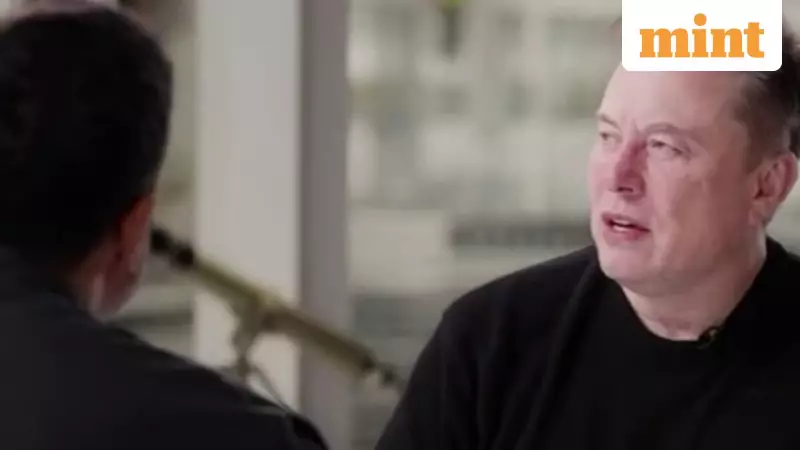
In a significant development for India's digital future, tech billionaire Elon Musk has expressed strong optimism about launching Starlink services in the country. The SpaceX CEO made these remarks during a conversation with Zerodha co-founder Nikhil Kamath on the 'People by WTF' podcast, signalling a potential new chapter for internet connectivity in India's underserved regions.
Starlink's Global Ambition Meets Indian Potential
Elon Musk revealed that his company's ambitious Starlink program is already operational in 150 different countries, providing low-cost and reliable internet on a global scale. He explicitly stated his desire to include India in this expanding network. "We’d love to be operating in India. That would be great," Musk affirmed, highlighting the country's strategic importance in Starlink's mission to bridge the digital divide.
How Starlink's Technology Works
The core of Starlink's offering lies in its constellation of thousands of satellites positioned in low-Earth orbit at an altitude of about 550 km. Musk explained that this proximity to Earth is the key to achieving low latency, resulting in faster and more responsive internet compared to traditional satellite systems. Furthermore, these satellites are not isolated; they form a sophisticated laser mesh network that interconnects them.

This design ensures remarkable redundancy and reliability. "If the cables are cut, the satellites can communicate with each other and provide connectivity," Musk noted, underscoring the system's resilience. This feature makes Starlink exceptionally valuable in emergency scenarios. The tech leader emphasized their policy of providing free Starlink internet connectivity during natural disasters, refusing to commercialize tragic situations.
Complementing, Not Competing, in the Indian Market
Musk provided a clear vision of where Starlink would fit into India's connectivity landscape. He positioned it as a perfect solution for rural and remote areas, where laying fibre optic cables or building high-bandwidth cellular towers is prohibitively expensive and logistically challenging. "Starlink is very complementary to the existing telecom companies," he stated, explaining that while cell towers are efficient in cities, they struggle in the countryside.
However, Musk was candid about the program's limitations. He acknowledged that physics prevents Starlink from effectively serving densely populated cities. With satellites hundreds of kilometers away, the technology cannot match the bandwidth potential of dense local networks in urban centers. This honest assessment clarifies that Starlink's primary mission in India would be to empower the hardest-to-reach communities, potentially transforming education, healthcare, and commerce in rural India.