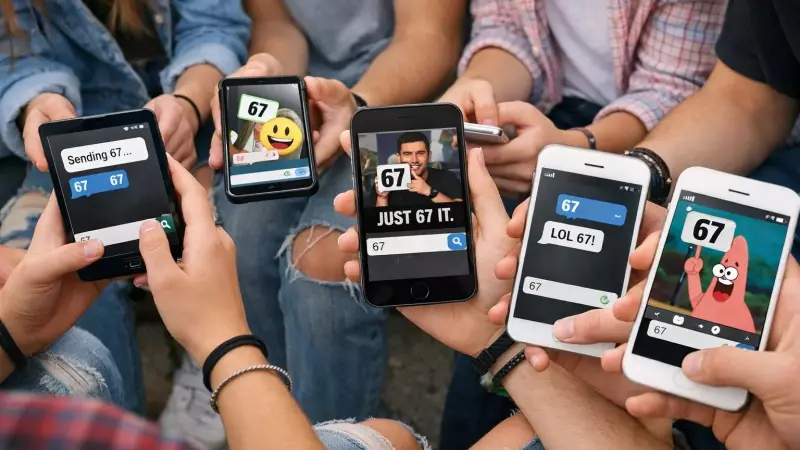
In a playful nod to one of the internet's most baffling trends, Google has secretly embedded a new Easter egg into its search engine. The feature activates when users type either '6-7' or '67' into the search bar. Instead of showing standard results, the entire screen begins to shake subtly. This animation mimics the hand gesture associated with the meme, where palms face up and move slightly up and down as if weighing options.
What Is The '67' Meme And Why Is It Viral?
The origin of the '67' or '6-7' trend is as elusive as its meaning. It appeared suddenly online, spreading rapidly due to its deliberate absurdity. There is no single, fixed definition. According to experts at Dictionary.com, some interpret it as meaning "so-so" or expressing indecision—"maybe this, maybe that." More often, it is used purely to provoke confusion or laughter, serving as an inside joke for digital natives.
In October 2024, Dictionary.com officially declared '6-7' its Word of the Year. The platform classifies it as a prime example of "brainrot slang." This category refers to expressions designed to be nonsensical and absurd, similar to previous viral terms like 'skibidi'. Interestingly, 'brain rot' itself was named Oxford's Word of the Year for 2024, describing a perceived decline in mental sharpness from consuming vast amounts of shallow online content.

Google Joins A Long Tradition Of Search Pranks
Google's integration of the '67' animation continues its long-standing practice of hiding playful jokes within its practical search tool. This new Easter egg works seamlessly on both desktop and mobile platforms. It joins classic examples like typing "do a barrel roll," which makes the page spin, or "askew," which tilts the screen.
These hidden features represent small, unexpected moments of fun engineered into the world's most used search engine. They demonstrate how Google's culture often intersects with and acknowledges viral internet phenomena, adding to a meme's digital footprint.
The Irony And Appeal Of Meaningless Slang
The true humour and viral power of '67' lie in its lack of a concrete meaning. Its randomness is central to its appeal. People drop the phrase into conversations where it clearly doesn't belong, leveraging sarcasm and irony. It functions as a social signal—those "in the know" pretend to understand, while others are left puzzled, which fuels further discussion and sharing.
Steve Johnson, director of lexicography for the Dictionary Media Group at IXL Learning, explained the choice. He stated that '6-7' is "part inside joke, part social signal and part performance." He emphasized that when people say it, "they're not just repeating a meme; they're shouting a feeling." He noted it's one of the first Words of the Year that works like an interjection—a burst of energy that connects people long before they agree on what it means.
Ultimately, Google's decision to feature this meme highlights how internet culture, even at its most seemingly nonsensical, can influence and be acknowledged by the biggest tech platforms. The shaking screen is more than a prank; it's a digital monument to a uniquely online form of communication.