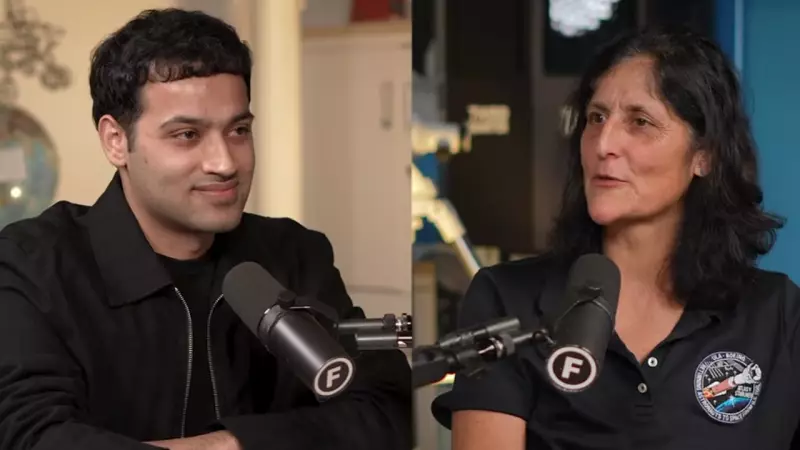
When astronauts gaze upon Earth from the vantage point of orbit, their descriptions rarely involve political boundaries or national borders. Instead, they perceive our planet as a vibrant, interconnected system where shifting patterns of light, color, and movement replace the rigid lines drawn on maps. This profound perspective was vividly articulated by Indian-origin astronaut Sunita Williams during her appearance on Raj Shamani's podcast, where she reflected on her experiences in space and offered remarkable insights into how India appears from above.
Sunita Williams Explains India's View from Space on Raj Shamani's Podcast
During their engaging conversation, host Raj Shamani posed a question that has intrigued many: How does India look from space? Williams responded with refreshing honesty, explaining that photographing India from orbit isn't always straightforward. She noted that atmospheric conditions—such as haze, clouds, humidity, and seasonal variations—can significantly affect visibility from the International Space Station. Some orbital passes provide crystal-clear, breathtaking views, while others render the landscape below somewhat blurred.
However, when conditions align perfectly, the spectacle is truly unforgettable. Williams described India at night as "pretty spectacular." What captivated her wasn't merely the brightness of urban centers but the remarkable interconnectedness of the illumination. Unlike many regions where city lights appear as isolated dots separated by vast darkness, India's nighttime glow presents as a continuous, flowing network. From her orbital perspective, cities, towns, and transportation corridors merge into a single, luminous system where lights feel intrinsically linked rather than randomly scattered.

"It Looks Like Connected Nerves"
The most striking element of Williams' description emerged when she drew a powerful analogy, comparing India's night lights to a network of nerves within the human body. She observed that the glowing patterns reminded her of medical illustrations depicting neural connections—branching, intersecting, and flowing seamlessly into one another. This comparison transcends mere visual description, suggesting a deeper, almost organic connectivity that defines India's illuminated landscape when viewed from space.
Sunita Williams' Space Missions Reveal How India Has Changed Over Time
Having traveled to space three times, Williams possesses a unique longitudinal perspective on Earth's evolving appearance. She noted that this pronounced sense of connected lighting was particularly evident during her most recent mission to the International Space Station, more so than in her earlier flights. This observation subtly hints at tangible changes in human development below—expanding urban areas, growing infrastructure networks, and increasing electrification across the subcontinent.
From the orbital viewpoint, these transformations manifest not as dry statistics or bureaucratic reports but as dynamic, evolving patterns of light spreading across the planet's surface. While the nighttime vista left an indelible impression, Williams also shared her observations of India during daylight hours. From orbit, the diverse terrain and vivid colors of the land become strikingly apparent, with geological features narrating their own ancient stories.
She spoke of the Himalayas as awe-inspiring formations that, when viewed from space, dramatically illustrate the convergence of tectonic plates—a slow yet immensely powerful geological process frozen in time. Williams also reflected on India's extensive coastline, particularly along the eastern seaboard where rivers meet the sea, creating colorful, swirling mixtures of sediment and water visible even from orbit.
Sunita Williams' Reflections on Space Travel, Retirement, and Earth's Interconnectedness
The podcast conversation extended beyond visual observations, delving into Williams' personal journey. She discussed her childhood, rigorous astronaut training, and the intense focus and teamwork required for living and working aboard the International Space Station for extended periods. With over 600 cumulative days spent in space throughout her distinguished career, Williams recently retired from NASA, marking a significant milestone in human space exploration history.

When Sunita Williams describes India's night lights as resembling "connected nerves," she is conveying something far more profound than mere brilliance or aesthetic appeal. Her words underscore a fundamental truth about our world: from the cosmic perspective, human activity reveals itself as intricate, living patterns that emphasize connectivity over division. Her insights remind us that borders are human constructs, while the luminous networks of light tell a story of shared existence and continuous transformation on our pale blue dot.