

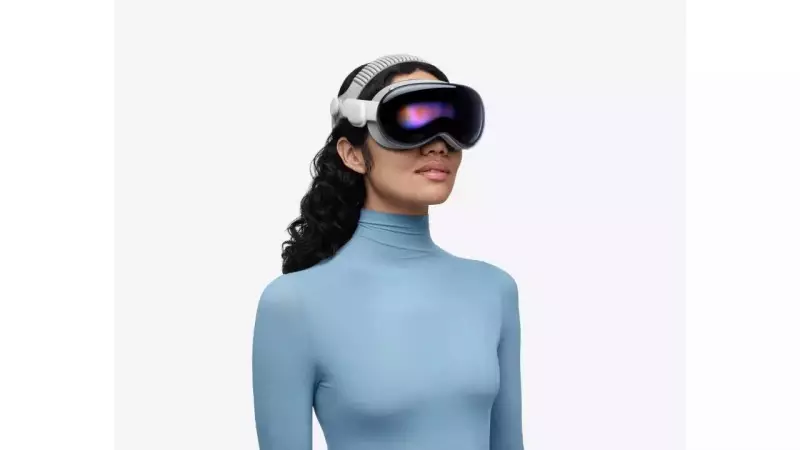
A Chinese tech startup named GravityXR is making waves in the extended reality (XR) industry with its announcement of a powerful new chip designed for mixed reality (MR) headsets and artificial intelligence (AI) glasses. The company claims its innovation not only matches but surpasses key specifications of the technology powering Apple's premium Vision Pro headset.
The Brains Behind the Breakthrough
Founded by Wang Chaohao, a Stanford graduate and former member of Apple's XR team, GravityXR last week introduced its flagship product: the all-in-one MR chip called Jizhi G-X100. According to a South China Morning Post report, this marks China's first use of advanced 5-nanometer technology in this specific chip category. The development has been hailed by early backers like the Yongjiang Lab in Ningbo as "a significant breakthrough for China in the area of spatial computing," which is the core tech blending real and virtual worlds.
How It Stacks Up Against Apple's Tech
The most direct comparison drawn is with Apple's Vision Pro. GravityXR states its G-X100 chip achieves a critical metric known as "photon-to-photon latency (PTP)" of just 9 milliseconds (ms). In contrast, Apple's Vision Pro reportedly has a PTP latency of 12 ms. He Wancheng, an analyst at XR consulting firm Wellsenn, explained why this matters: longer delays disrupt the seamless fusion of virtual content with the real environment, leading to user discomfort and visual confusion.

Beyond speed, the Yongjiang Lab highlighted that the new chip solves a fundamental challenge for wearable devices by being fast and powerful while consuming very little energy. This efficiency is crucial for the next generation of lightweight AI glasses, potentially enabling them to weigh under 100 grams.
Driving the Future of XR and AI Wearables
The Jizhi G-X100 is expected to be a core component in upcoming high-end Chinese XR headsets and sleek AI glasses. GravityXR didn't stop at one chip; it introduced two additional chips. One is focused on recording high-quality video through devices like AR glasses, and the other is optimized for low-power creation of spatial and 3D images.
The company boasts impressive financial backing from major investors including HongShan (formerly Sequoia Capital China), Gaorong Capital, electronics maker Goertek, and game developer miHoYo. Its client list, as per a Ningbo Daily report, features names like Meta Platforms, Goertek, and robotics firm Agibot.
This innovation arrives as the global XR market shows promising growth. Consulting firm Counterpoint Research projects global XR display shipments to grow 6% this year, with AR glasses shipments surging by 42% in the same period. GravityXR's chip could position Chinese manufacturers strongly in this competitive and expanding landscape.






