

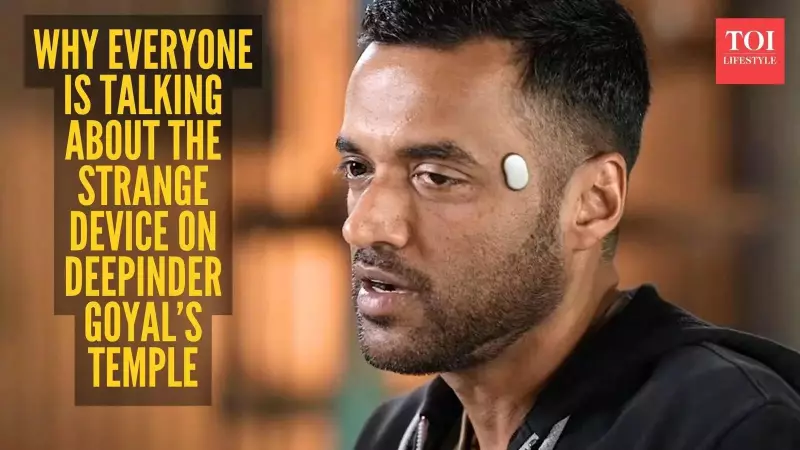
During a recent appearance on Raj Shamani's popular 'Figuring Out' podcast, Zomato founder Deepinder Goyal sparked an unexpected online storm. While viewers tuned in for insights on business and leadership, their attention was quickly hijacked by a small, metallic device subtly attached near Goyal's temple.
The Internet's Viral Detective Work
Within minutes of the podcast going live, eagle-eyed social media users began dissecting the mysterious object. The internet erupted with speculation, transforming the tiny gadget into the episode's main talking point. Was it a piece of chewing gum? A medical patch? Jokes flew, with one user quipping it was an "external SSD," while others pondered if it was a futuristic charging pad or even an implant.
The viral moment proved that even the smallest detail on a prominent figure can capture the public's imagination, overshadowing the planned conversation.

Revealing the Science Behind Temple
The gadget, as Goyal later clarified, is far more intriguing than any meme. It is an experimental wearable named 'Temple,' designed to track blood flow to the brain in real-time. Goyal explained this was not a fashion statement or a marketing gimmick. He has been personally testing the device for nearly a year as part of his deep dive into brain health and the science of ageing.
The core function of Temple is to continuously monitor cerebral blood circulation. Scientists consider this a critical biomarker for ageing, cognitive function, and overall neurological health. In essence, it acts like a fitness tracker, but for the brain.
Exploring the Gravity Ageing Hypothesis
Goyal connected the device to a theoretical framework he and his team are investigating, called the 'Gravity Ageing Hypothesis.' This concept proposes that over decades, gravity may contribute to reduced blood flow to the brain, potentially influencing how we age. While this bold idea has generated both curiosity and scepticism in scientific circles, Goyal emphasized the need for a tool that could measure brain blood flow accurately and continuously in daily life—a gap in current wearable technology.
"So, they built one," Goyal stated. He added that even if the gravity theory isn't fully validated, monitoring brain blood flow remains a valuable research pursuit due to its established link to cognitive health.
A Research Project, Not a Startup
Goyal was quick to manage expectations, clarifying that Temple is not intended to be the next Zomato-scale venture. He described it as a modest research project that may or may not evolve into a commercial company. He strongly stressed that the device was not created to promote the Gravity Ageing Hypothesis, nor was its appearance a publicity stunt, asserting he would never risk his credibility for such a purpose.
The device's brief, casual appearance on a mainstream podcast is what fueled its viral status. Such experimental tools are typically confined to labs or clinical settings. Seeing one in the wild, during a relaxed interview, broke the norm and ignited public curiosity about the future of wearable tech, health monitoring, and longevity research.
From Memes to Meaningful Conversation
While social media had a field day with humorous comparisons, the underlying reaction was one of genuine fascination. For now, Temple remains firmly in the experimental phase with no consumer launch, pre-orders, or promises of a mainstream product. However, its accidental debut has successfully pushed topics like brain health, ageing science, and advanced wearables into the realm of everyday discussion.
Whether Temple becomes a widely available health tool or remains a niche research instrument, one thing is clear: Deepinder Goyal didn't just talk about innovative ideas on the podcast—he was literally wearing one on his face.






