

Delhi Ministers Launch Startup Yuva Festival 2026 to Bridge Campus Innovations with Market Realities
Union Minister of State for Skill Development and Entrepreneurship Jayant Chaudhary joined Delhi Chief Minister Rekha Gupta on Wednesday to inaugurate the 'Campus to Market - Delhi Startup Yuva Festival 2026'. The event took place at the Dr Ambedkar International Centre in New Delhi.
The Directorate of Training and Technical Education (DTTE) of the Delhi Government organized this flagship program. Both ministers actively engaged with young innovators, teachers, investors, and startup founders from various universities, colleges, and technical institutions.
Ministers Applaud Student Creativity and Problem-Solving
Jayant Chaudhary and Rekha Gupta toured the startup exhibition, examining numerous innovations, prototypes, and business models. They expressed genuine appreciation for the creativity, technological outlook, and problem-solving abilities displayed by young entrepreneurs.

The leaders held detailed discussions with several student teams. They talked about startup ideas, market strategies, and potential social impact. The ministers assured the young innovators of continued guidance and support to help transform their ideas into real-world solutions.
Delhi Government Cabinet Minister Ashish Sood and other dignitaries also attended the inauguration ceremony.
Jayant Chaudhary Emphasizes Skill-Based Education and Youth Power
Union Minister Jayant Chaudhary highlighted India's immense youth power, which provides the nation with tremendous working capacity. He stated that the true benefit of this demographic advantage will only materialize when young people receive opportunities to advance, their talent gets recognized, and their skills are refined.
"Earlier, the education system almost closed its doors to students who did not fit the traditional academic framework," Chaudhary remarked. "Even universities focused largely on textbook-based learning. The prevailing mindset was that only formal education mattered."
He noted that under Prime Minister Narendra Modi's vision and the National Education Policy, this thinking is undergoing a significant transformation. "Today, the focus should be not merely on degrees but on capabilities," Chaudhary asserted. "This is possible only through skill-based education, experiential learning opportunities, and exposure to the real world."
CM Rekha Gupta Hails Youth as Job Creators, Not Just Job Seekers
Chief Minister Rekha Gupta observed that today's youth is emerging as 'job creators' rather than merely 'job seekers'. She praised student startups in Delhi for demonstrating exceptional creativity and innovation. These startups offer practical solutions to contemporary social, environmental, and technological challenges.
"Under the leadership of Prime Minister Narendra Modi, a strong startup and innovation ecosystem has developed across the country," Gupta said. "This ecosystem provides young people with the platforms, policies, and support needed to journey from idea to enterprise."
The Delhi CM announced that her Government is working rapidly to integrate education, skills, and entrepreneurship. The goal is to position the capital as the Startup Capital of India. She urged the youth to adopt a solutions-driven mindset for the nation, enabling Delhi and India to lead global innovation.
Education Minister Ashish Sood Details Delhi's Startup Transformation
Delhi's Education Minister Ashish Sood provided concrete details about the evolving startup landscape. He acknowledged that startups existed in Delhi earlier but were scattered. There was no clear startup policy or structured mechanism to connect students with industry, mentors, and investors. Initiatives related to education and startups were largely limited to announcements.
"This mindset has now completely changed," Sood declared. "The state Government is building an ecosystem from school education to higher and technical education. We are placing skill development, entrepreneurship, and innovation at the core, with public and private institutions working together."

He presented the Startup Yuva Festival as a prime example of this transformation. For the first time, the event brought together 11 universities, 12 colleges, and 19 ITIs on a single platform. The 'Campus to Market' approach is now implemented in a structured manner, providing students with access to mentorship, funding, and markets.
Impressive Numbers Showcase Delhi's Entrepreneurial Momentum
Minister Sood shared compelling statistics that illustrate the scale of Delhi's entrepreneurial push:
- More than 75,000 students and young people are currently engaged in entrepreneurship programs.
- Over 470 startups are in incubation stages.
- These student startups have collectively generated Rs 500-600 crore in revenue.
- Each startup creates an average of 4-5 jobs.
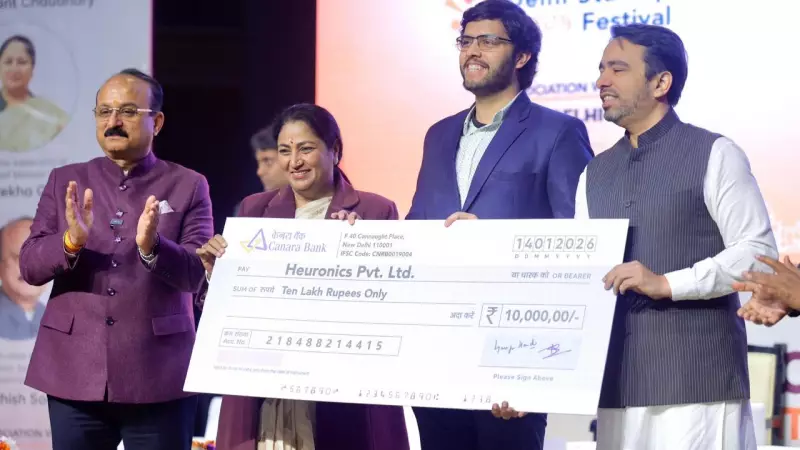
At the school level, under the NEEEV curriculum, 5,000 student teams have received assistance of Rs 20,000 per team. During the Startup Yuva Festival, the top six startups received equity-free grants of Rs 10 lakh each. The top 100 startups received Rs 1 lakh each.
Sood made a significant announcement: The Delhi Government will soon implement the Delhi Startup Policy. This policy will have a provision of Rs 325 crore over the next five years. It aims to develop 5,000 startups by 2035.
Festival Structure and Objectives
The Startup Yuva Festival 2026 represents the Delhi Government's flagship program to establish Delhi as India's Startup Capital. Organized by the Delhi Government, the festival serves as a major initiative to take student-led startups from campus to market. Its primary objective is to convert innovations developed within educational institutions into commercially viable and sustainable enterprises.
Under the 'Campus to Market' initiative, students presented their ideas directly to investors, mentors, and industry experts. The program featured knowledge sessions, policy roundtables, and an award ceremony.
The festival received more than 700 applications. Over 60 startups participated in the Startup Expo, with the top 20 selected for live pitching sessions. As previously mentioned, the top six startups won Rs 10 lakh each, while the top 100 received Rs 1 lakh each.





