

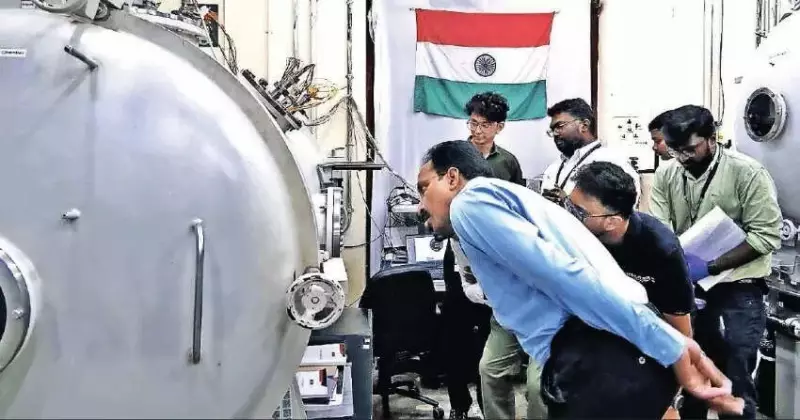
Building a rocket engine that only functions in the vacuum of space presents a unique challenge: how do you test it on Earth, inside a warm, air-filled laboratory? A Bengaluru-based startup, Bellatrix Aerospace, has tackled this problem head-on by constructing sophisticated machines that mimic the absolute void of space hundreds of kilometres above our planet.
Recreating Space on Earth: A DIY Engineering Marvel
Inside its lab on the Indian Institute of Science (IISc) campus, Bellatrix operates custom-built systems that replicate the harsh environment of outer space. Yashas Karanam, the company's co-founder and COO, explains that their propulsion systems are not for launching rockets but are vacuum engines designed to manoeuvre satellites once they are already in orbit. "These engines are used to reorient the spacecraft once it is in space," Karanam states.
To test these engines, the company must create space-like conditions on the ground. This involves a complex array of pumping systems—including roughing pumps, roots pumps, rotary vane pumps, turbo-molecular pumps, and cryogenic pumps—working together to remove air particles. The final step uses cryogenic plates cooled to near absolute zero to trap any remaining residual particles.

Founded in 2015 by engineers Yashas Karanam, Rohan M Ganapathy, and Nuthan Prasanna Kumar, Bellatrix has raised over $11 million in funding and counts ISRO among its customers. What sets them apart is their decision to design and build much of their critical infrastructure in-house. "The machine is our own customised one," says Karanam. The reason is straightforward: affordability. Buying such specialised equipment from overseas would have been prohibitively expensive and slow. This DIY ethos extends to their diagnostic machines and vacuum chambers, built by a dedicated team of PhDs within the company.
Pioneering Green Propulsion and Advanced Thrusters
Bellatrix's work extends into the crucial area of green chemical propulsion. Traditionally, satellites have used hydrazine, a highly toxic and carcinogenic fuel. The startup has developed a safer, high-performance alternative based on hydroxyl ammonium nitrate. "I can touch it like this safely," Karanam remarks, highlighting its non-toxic nature. This innovation allows satellites to be fuelled safely at the manufacturing site and shipped ready for launch.
In another section of the lab, a tiny Hall-effect thruster is mounted inside a vacuum chamber. It uses xenon or krypton gas to generate plasma for thrust. Bellatrix has built its own plasma diagnostics rigs to measure critical parameters like ion density and plume behaviour. A miscalculation here could cause the plasma to fall back onto the satellite, creating dangerous electrical charges.
The company has also developed some of the world's smallest Hall thrusters, featuring a heaterless cathode design. This allows the thruster to fire instantly in orbit, a significant improvement over older systems that required a lengthy warm-up period. "Heaters are the first things to fail," Karanam notes, explaining how this design enhances overall reliability.
Ambitions for Ultra-Low Earth Orbit and Global Scaling
The foundational research at the IISc lab fuels Bellatrix's ambitious long-term goal: enabling ultra-low Earth orbit satellites that operate at altitudes as low as 200 kilometres. At this height, atmospheric drag is a major challenge, requiring continuous and highly efficient thrust to maintain orbit. Bellatrix is leveraging its deep, in-house knowledge of propulsion physics to solve this complex problem.
With an eye on the future, the company is preparing to scale up its operations. It has plans for a large five-acre manufacturing facility near Bengaluru's airport, capable of producing hundreds of propulsion systems annually. Having recently expanded into the United States, Bellatrix is also exploring setting up a manufacturing base there, marking its transition from a pioneering Indian startup to a serious global player in the new space economy.






