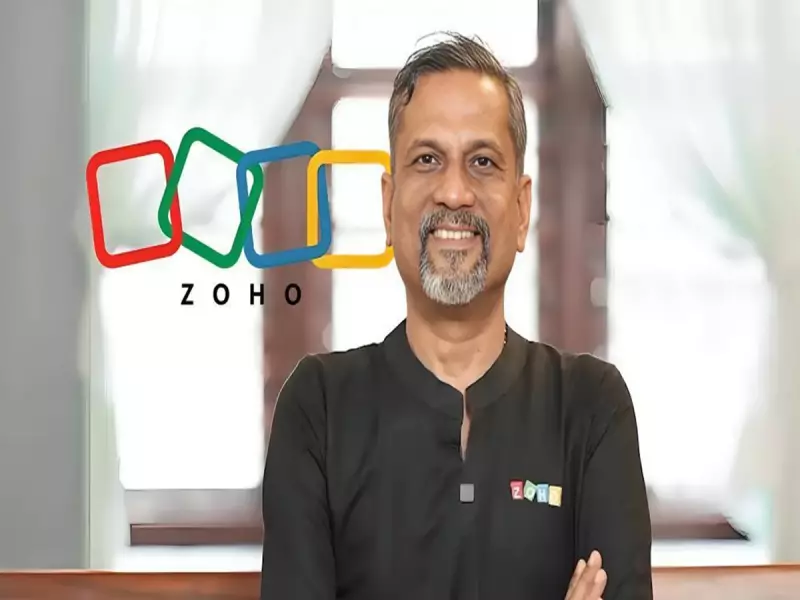
For generations, a person's employability in India was almost solely judged by their academic credentials. A graduate degree, a master's, or a PhD were the golden tickets to a secure career. But what if this long-standing reign of degrees in the job market is finally approaching its end? This is not a hypothetical question or clickbait, but a serious argument put forth by Sridhar Vembu, the co-founder of the global software giant Zoho.
The American Precedent and a Cultural Rupture
Vembu believes a generation can truly thrive without traditional degrees, credentials, and elite college pedigrees. He points to a significant cultural shift happening in America, which India, in his view, is ignoring at its own peril. In his social media posts, Vembu highlighted that the next wave of tech talent is emerging not from hallowed university campuses but from bold teenagers who choose to walk past them.
He cited the headline-making experiment by data analytics firm Palantir, which recruited 22 high-school graduates directly into high-stakes work on national security and advanced technology. This move sent an intentionally provocative message: skip the massive student debt and the perceived indoctrination of college. For Vembu, this represents youth autonomy—the ability to step into economic adulthood without first sinking years and money into what he sees as a volatile higher-education system.

His remarks come when faith in American universities is eroding rapidly. A Pew Research Center survey found that 70% of Americans believe higher education is on the wrong track, and 55% think colleges fail to prepare students for well-paying jobs. Palantir CEO Alex Karp has aggressively criticized elite universities as breeding grounds for extremism, valuing hands-on experience over an Ivy League diploma.
A Philosophy Practiced at Zoho and Tenkasi
Vembu's argument is not based on foreign examples alone. He has built Zoho in defiance of Silicon Valley norms and applies the same contrarian philosophy to hiring. At Zoho, no job officially requires a college degree. Vembu revealed that if any manager posts a requirement for a degree, they receive a polite message from HR to remove it.
The living proof of his conviction is Zoho's Tenkasi unit in Tamil Nadu, one of India's most unconventional tech labs. There, he works with a technical team whose median age is just 19. Vembu asserts that these teenagers bring more energy, adaptability, and raw talent to the table than many credentialed applicants from traditional backgrounds. This, to him, is the future: talent discovered early, trained deeply within the company, and empowered structurally without waiting for formal education to catch up.
Is India Ready to Let Go of Its Degree Obsession?
The Indian middle class remains deeply invested—emotionally, financially, and socially—in the conventional college pipeline. Degrees are still treated as essential insurance policies against an uncertain future. Success is often measured by admission into prestigious institutes, and many employers, even in new-age sectors, continue to use degrees as a primary filter.
However, the global job market is shifting faster than these cultural norms. Automation is shortening skill lifecycles, and digital industries increasingly reward speed, adaptability, and practical problem-solving over paper qualifications. Vembu warns that the cultural shockwaves from America's growing anti-degree movement will inevitably reach Indian shores.
The uncomfortable question India must now confront is stark: What happens when the global economy stops caring about degrees as much as Indian society still does? Vembu's call is a warning that clinging to outdated pathways may leave Indian youth underprepared for a labour market that is rapidly rewiring itself.
The core question is no longer whether degrees matter—they still hold value in many fields. The real dilemma is whether degrees alone can remain the sole foundation of aspiration and employability in a world where merit is being measured differently, earlier, and more aggressively based on demonstrable skill and output.