

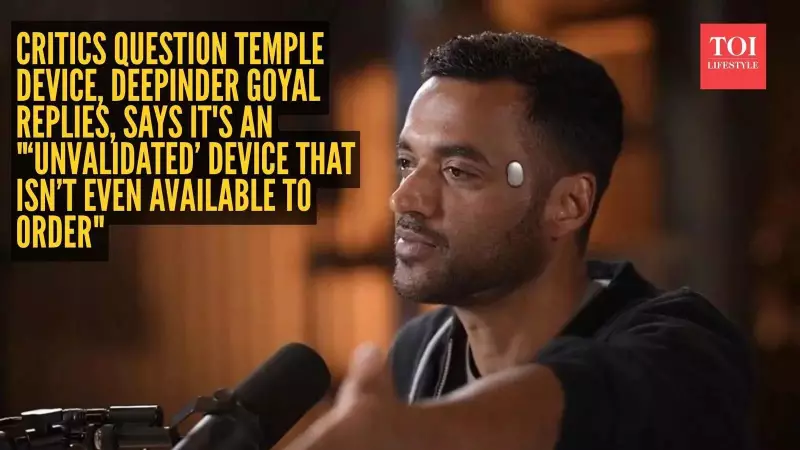
Deepinder Goyal, the founder and CEO of food delivery giant Zomato, has once again captured public attention, but this time it's not about food. The spotlight is on a compact wearable device named 'Temple', which Goyal was recently seen sporting during a YouTube podcast. This novel gadget is designed to monitor blood flow in the brain in real-time, sparking a wave of curiosity and debate across social media and medical circles.
What is the Temple Device?
The device, as its name suggests, is worn near the temple. Its primary function is to track cerebral blood flow, which is considered a vital indicator of brain health, ageing, and cognitive function. The technology is rooted in Goyal's personal research interest, termed the 'Gravity Ageing Hypothesis'. Reports from Mint indicate that Goyal has invested a substantial $25 million (approximately ₹225 crore) of his personal wealth into developing this ambitious project. The device entered the public consciousness after Goyal wore it during an interview with YouTuber Raj Shamani.
Goyal's Clarification on X: Still in Testing Phase
Following the online buzz, a mix of intrigue and scepticism emerged, with some doctors and influencers questioning the device's validity and accuracy. On January 9, Goyal took to the social media platform X to address the growing speculation head-on. He made it unequivocally clear that Temple is not a finished product ready for consumers.

In his post, Goyal stated, "We haven’t made any public commercial announcements about Temple yet. We haven’t released any official device benchmarking data." He emphasized that significant work remains, adding, "A lot of the work is still underway; we’re months away from introducing preview devices to the public, if at all." This official communication confirms that the device is firmly in the research and development phase, with no official performance data available for public scrutiny.
Responding to Early Critics and a Call for Patience
Goyal directly responded to the early wave of criticism from sceptics who advised against purchasing an "unvalidated" device. He found the timing of such advice premature, noting the device isn't even available for order or pre-order. "That’s funny," he remarked, suggesting that judgement should be reserved for a later stage.
He urged the public and critics alike to adopt a posture of curiosity rather than conclusive judgement at this early stage. Goyal affirmed that the scientific underpinnings and data for Temple will be fully disclosed only when and if the company decides to bring it to market. "We will share all the science if and when we decide to sell Temple. You can judge and give all your advice at that moment," he wrote, concluding with an appeal to "be curious, and cheer Indian startups."
The episode highlights the intense scrutiny faced by high-profile entrepreneurs venturing into new, complex fields like health tech. While Goyal acknowledges that scepticism is valuable, he insists it must be applied "at the right time." For now, Temple remains a prototype, a glimpse into a potential future of personal brain health monitoring, championed by one of India's most well-known startup founders.






