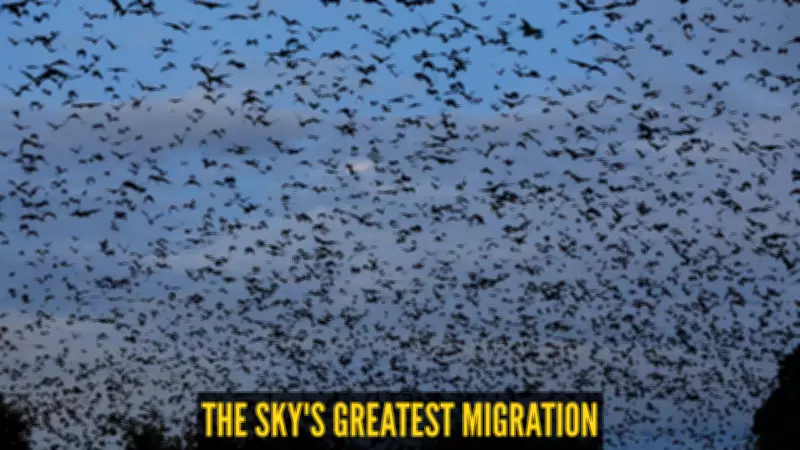
Mention the Serengeti wildebeest or sweeping herds of antelope, and most people instantly picture Africa's great migrations. But the biggest mammal migration on the planet doesn't actually happen on the typical safari trail. It features a creature most tourists barely spare a thought for. Every year, the skies above a tiny pocket of forest in northern Zambia go completely dark as roughly 10 to 15 million straw-coloured fruit bats fly to Kasanka National Park.
For a brief, spectacular window, this quiet patch of Africa puts on a show so massive that meteorologists pick it up on weather radar. It's an unbelievable, under-the-radar treat for nature buffs, photographers, and anyone looking for a truly wild experience.
The Mammals Behind the Spectacle
The true stars of this show are straw-coloured fruit bats (Eidolon helvum), which rank among Africa's largest fruit bat species. You can easily spot them by their golden-brown coats, dark wings, and impressive wingspans that stretch to nearly a metre.

Unlike others, these bats rely on sharp eyesight and a keen sense of smell to track down fruiting trees over huge distances. They're highly social creatures, hanging out in vast colonies right across tropical Africa, and they do heavy lifting as some of the continent's top seed dispersers. What really sets them apart is their sheer stamina. Trackers have clocked individual bats covering over 2,500 kilometres, with some flying upwards of 370 kilometres in a single night. That officially makes them the longest-distance migrating mammals in Africa.
Journeying Through the Heart of Africa
Sometime between late October and mid-December, these millions of bats descend upon Kasanka National Park in Zambia's Central Province, having travelled from the Congo Basin and other equatorial forests. They don't just follow a set map like wildebeest at a river crossing. Instead, they chase the rains and seasonal food. Researchers call it riding Africa's "green wave", tracking the flush of fresh vegetation and ripening fruit that follows the wet season.
As the rains hit northern Zambia, local evergreen swamp forests, known locally as mushitu, spring to life. This creates a buffet for the exhausted, hungry bats. Lured by the feast, the entire colony squeezes into a remarkably small 25-hectare patch of forest within the park.
Why Kasanka?
It all comes down to a single necessity: food. The rain acts as a starting gun for native trees like the waterberry, red milkwood, and wild loquat to bear fruit. The bats desperately need this massive energy boost to prep for breeding and rearing their young. A single bat can easily eat double its own body weight in fruit overnight. When you multiply that by millions, the numbers are staggering. Over a three-month stay, the colony will chew through more than a billion fruits.
But it's not just a feeding frenzy; it's a vital ecological service. As they digest and drop seeds on the fly, they help regenerate forests across vast stretches of land, bridging ecosystems that are hundreds or even thousands of kilometres apart. It's no wonder conservationists affectionately dub them the "Gardeners of Africa".
When the Sky Turns Black
For anyone visiting, witnessing the daily routine is where the real magic happens. The buildup starts just before sunset. With the dusk, the forest erupts with an incredibly loud chorus of chatter and screeches. Then, the first groups take off. Minutes later, millions more come flying in the air. The sky looks like a sprawling river of ink. Huge, swirling clouds of bats corkscrew upwards before streaming out across the horizon to find dinner. The sheer volume makes it look like the movement stretches on forever. It's a totally different experience from spotting a leopard or an elephant; you are quite literally watching an entire ecosystem in motion.

The Best Time to Visit
You have to get the timing right. While the bats start arriving in late October and stick around until early January, the absolute peak falls between mid-November and early December. That's when the colony is at its maximum size, guaranteeing you'll see the dramatic evening exodus at its best. If you visit outside this window, you'll miss the phenomenon entirely as the bats scatter back across the continent. Travellers should ideally aim for late November to strike the perfect balance between good weather conditions and maximum bat numbers.
Experiencing Kasanka First-Hand
One of the best things about the Kasanka migration is the intimacy. You won't find the massive crowds or traffic jams of safari vehicles that plague other famous African wildlife spots. You'll likely share the viewing spots with just a handful of other lucky travellers. The prime lookout is Fibwe Hide, a sturdy platform hoisted high up in a mahogany tree overlooking the canopy. Sitting up there puts you right at eye level with the bats as they launch from their roosts.
Plus, there's plenty more to see in the park. Keep an eye out for antelope species like sitatunga, puku, and black lechwe, along with a massive variety of birdlife. Many visitors also tack on a trip to the nearby Bangweulu Wetlands to spot the rare, prehistoric-looking shoebill stork.
Getting There
Kasanka National Park sits about 520 kilometres north of Lusaka, Zambia's capital. You can drive up from Lusaka, a journey that takes roughly six to eight hours. You'll definitely want a four-wheel-drive vehicle, especially since the rains can quickly turn dirt roads to mud. If you're short on time, you can book a charter flight straight from Lusaka to the park's own airstrip to skip the long drive altogether. A quick note for Indian travellers: you'll need to secure a visa to enter Zambia. A valid Yellow Fever vaccination certificate is also a strict requirement, particularly if you're arriving from or transiting through countries within the disease risk zone.
A Wonder Worth Protecting
Even with its massive global significance, this migration faces serious threats from deforestation, agricultural expansion, and general habitat loss around the park boundaries. The conservation groups and local authorities are working to protect the bats and the forests they depend on. Sustainable tourism plays a huge part in this; by visiting, you're directly helping to fund conservation programmes and providing economic support to the surrounding communities. Watching millions of bats rise into the Zambian twilight and block out the sky makes it obvious why this is one of the planet's most incredible sights. Remote, spectacular, and brilliantly undiscovered, it remains one of the continent's greatest natural wonders, and truly Africa's best-kept wildlife secret.