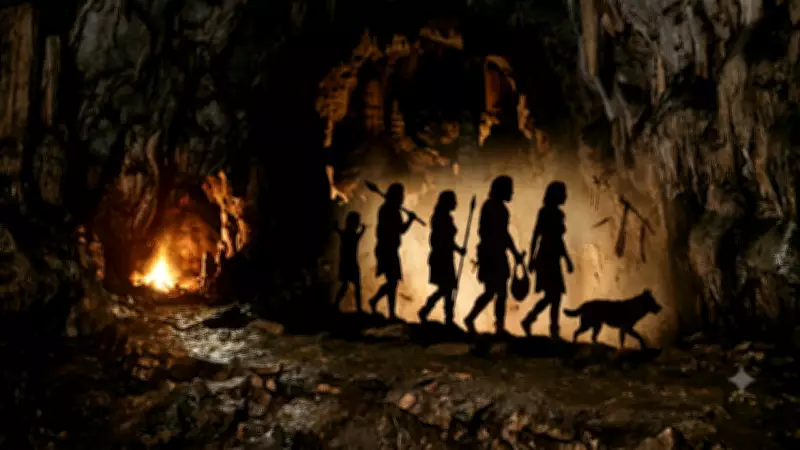
Imagine stepping into complete darkness with nothing but a few burning pine branches to light the way. No maps. No ropes. No idea what lies ahead. Around 14,000 years ago, a small group of people did exactly that when they entered a cave in what is now northern Italy. They were not alone. Travelling with them was a canid, possibly an early dog or a wolf-like companion.
At first glance, the discovery may sound simple: a few ancient footprints preserved in a cave. Yet for archaeologists, it is one of those rare moments where the past suddenly feels personal. Instead of broken tools or scattered bones, they found something much more intimate, the actual traces of a journey made by real individuals thousands of years ago.
A prehistoric adventure frozen in mud
The story comes from Bàsura Cave, where researchers uncovered a trail of footprints left by five people. Based on the size of the tracks, the group included five individuals, composed of two adults, an adolescent, and two children, who entered the cave barefoot, lighting the way with a bunch of wooden sticks.

That detail surprised researchers. It is always envisioned that caves of the Ice Age era must be explored by skilled hunters or adults embarking on dangerous journeys. However, in this case, the explorers were apparently children small enough to make visible imprints on the soft soil of the cave.
The imprints depict them exploring the cave further, moving through tight gaps, negotiating obstacles, and carefully walking over slippery patches.
According to an article titled 'Following the Father Steps in the Bowels of the Earth: The Ichnological Record from the Bàsura Cave (Upper Palaeolithic, Italy)', the imprints capture only one occasion of exploration, which occurred about 14,400 years ago.
Lighting the darkness with pine torches
The cave would have been pitch-black beyond the entrance. To navigate it, the group carried burning pine branches. Scientists found traces of charcoal and burnt pine wood, suggesting that resin-rich pine was used as a natural torch. It was a practical choice. Pine burns brightly and produces enough light to move through unfamiliar underground spaces.
What stands out is the planning involved. This was not a case of people wandering into a cave by accident. They prepared for the journey beforehand, gathered light materials, and ventured inside together. For archaeologists, that hints at curiosity, cooperation, and perhaps even a sense of adventure.
The animal that followed them underground
According to a research paper 'The dog domestication: new ichnological evidence from the Upper Palaeolithic of the Bàsura cave (Toirano, NW Italy)', among the human footprints were tracks left by a canid. Researchers cannot say with complete certainty whether the animal was a domesticated dog or a wolf closely associated with humans. Either way, its presence raises fascinating questions about the relationship between people and canids near the end of the Ice Age.
The animal appears to have travelled alongside the group rather than wandering independently. It would serve as additional proof of how connected the history of humans and dogs had become even by that point.
More than footprints at a cave
What makes this finding stand out is not just its age but the image it brings to mind, the idea of one day in the life of our ancestors thousands of generations ago. It is easy to imagine: flickering torches reflecting from the walls of a cave, parents leading children through dark passageways, with an animal following at their heels. For a second, time becomes irrelevant, and the Ice Age seems much closer.
This discovery not only sheds light on early human behavior but also on the deep history of human-animal companionship. The footprints in Bàsura Cave are a rare window into a moment of shared experience between humans and canids, a bond that would eventually lead to the domestication of dogs.