

Ancient Filipino Mariners Rewrite History as Pioneers of Seafaring
Groundbreaking archaeological discoveries are fundamentally reshaping our comprehension of prehistoric human activity in Southeast Asia. A paradigm-shifting revelation positions the early inhabitants of the Philippine archipelago not as isolated, stranded groups, but as the true pioneers and innovators of open-ocean sailing.
Evidence of Advanced Maritime Networks
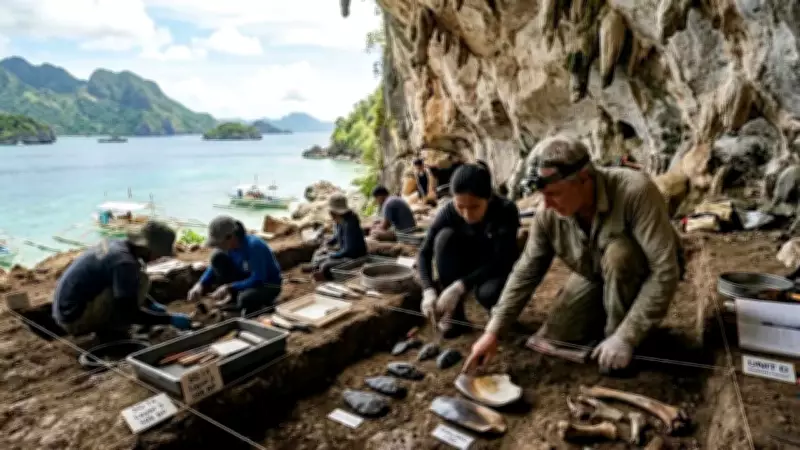
Research centered on evidence from Mindoro Island demonstrates that over 40,000 years ago, human communities were already navigating vast open-ocean corridors. These early peoples engaged in sophisticated pelagic fishing and established complex, interconnected societies whose technology and culture were intrinsically linked to the water. This directly contradicts the long-standing academic belief that these islands were populated accidentally by humans adrift at sea, viewed as remote and isolated outposts.
Modern scientific analysis of artifacts found on the islands reveals advanced tool-making methods specifically designed for processing shellfish. Furthermore, the discovery of pelagic fish remains at sites far from any coastline provides irrefutable proof that people were undertaking deliberate, repeated voyages between landmasses. As researchers map these ancient interactions, it becomes clear that the waters surrounding the Philippines served as a primary conduit for community interaction, fostering the development of robust networks dedicated to trade and cultural exchange.

Integrated Island Settlements and Sustained Activity
The findings indicate that humans established extensive island networks across the Philippines. Data from the Mindoro Archaeology Project suggests that early societies utilized caves and rock shelters not as isolated dwellings, but as components within a broader, interdependent system of integrated settlements. Instead of evidence for sporadic occupation, researchers have documented continuous human activity at these locations spanning more than 35,000 years.
This sustained presence points to these sites being integral nodes in an extensive system that facilitated the sharing of knowledge, materials, and culture across communities separated by hundreds of miles of ocean. A study conducted at Ateneo de Manila University underscores this interpretation, highlighting a networked society rather than isolated tribes.
Technological Mastery: Crafting Watercraft and Tackling the Deep Sea
The geological fact that no land bridges connected these islands during the Ice Age necessitates one conclusion: reaching them required organized, purposeful seafaring efforts. The Ateneo de Manila University study provides the technological evidence. Microscopic examination of ancient stone tools shows these early settlers possessed the knowledge to create ropes and nets from plant fibres.
This technology was crucial for constructing watercraft and the specialized gear required for deep-sea fishing. The archaeological record, which includes remains of tuna and shark, confirms they successfully accessed rich marine resources far offshore. Their maritime capability was not incidental but a cornerstone of their survival and expansion.
Coastal Innovation Overcoming Isolation
By ingeniously leveraging their coastal environment, the early island residents demonstrated remarkable adaptability, devising solutions to overcome environmental constraints. A key innovation was the creation of an adze—a woodworking tool—crafted from giant clam shells. This tool enabled the precise shaping of wood into essential items: paddles, shelter components, and critical parts for their vessels.
The ability to shape wood effectively was transformative. It allowed for the creation and maintenance of maritime networks that transported both physical goods and intangible cultural elements over vast distances. This capability virtually linked island populations in a manner that completely challenges the traditional historical paradigm of primitive, isolated communities. Their story is one of intentional connection and technological mastery, rewriting the narrative of human migration and cultural development in ancient Southeast Asia.






