Scientists Create Artificial Solar Eclipse in Space to Unlock Sun's Secrets
For countless centuries, humanity has gazed upon the Sun as a familiar yet mysterious presence in our sky. While appearing as a constant, radiant sphere of light, the reality of our star is far more turbulent and complex than meets the eye. Behind its seemingly serene exterior lies a dynamic world of extreme temperatures, powerful magnetic fields, and explosive energy releases that have remained largely hidden from detailed observation.
Breakthrough Space Experiment Overcomes Solar Brightness
Until recently, the Sun's overwhelming brightness has prevented scientists from closely examining many of its most fascinating phenomena. However, researchers have now achieved a remarkable breakthrough through an innovative space-based experiment. By creating an artificial eclipse in orbit, scientists have successfully captured unprecedented footage of massive plasma structures erupting from the Sun's atmosphere. These awe-inspiring images not only captivate the imagination but also provide crucial insights into understanding our star's behavior and its role in the universe.
How Scientists Engineered a Space-Based Solar Eclipse
To address the challenge of solar observation, researchers turned to advanced space technology. The European Space Agency's Proba-3 mission utilizes two satellites flying in perfect formation, maintaining a precise distance of approximately 150 meters between them. In this sophisticated arrangement, one satellite acts as an occulter, mimicking the Moon's function by blocking the Sun's brilliant center.

The second satellite, called the coronagraph, positions itself with millimeter precision within the occulter's shadow. Shielded from the Sun's intense glare, this instrument can photograph the corona with exceptional detail. This delicate positioning requires extraordinary accuracy as both satellites maintain their formation while orbiting Earth at high velocity.
Historic Five-Hour Artificial Eclipse Achievement
In September 2025, the Proba-3 mission accomplished a groundbreaking feat by creating a continuous artificial eclipse lasting nearly five hours. During this extended observation window, the coronagraph captured images of the Sun at five-minute intervals, enabling researchers to compile a comprehensive time-lapse video of the Sun's outer atmospheric movements.
To enhance their understanding, scientists combined these images with data from NASA's Solar Dynamics Observatory, which monitors the Sun's surface activity. This integrated approach allowed simultaneous observation of both the solar surface and corona, revealing direct connections between surface phenomena and coronal events.
Discovery of Massive Plasma Structures
As part of these observations, researchers identified three enormous plasma formations rising and peeling away from the Sun's surface. These structures represent significant discoveries that contribute to our understanding of solar dynamics and space weather phenomena.
The Mysterious Solar Corona: Hotter Yet Harder to Observe
The corona constitutes the outermost layer of the Sun's atmosphere, extending millions of kilometers into space. One of its most intriguing characteristics is its temperature paradox: despite being farther from the Sun's core, the corona reaches temperatures exceeding one million degrees Celsius, while the solar surface maintains approximately 5,500 degrees Celsius.
The primary challenge in observing the corona stems from its relative dimness compared to the Sun's brilliant surface. The solar disk's intense brightness overwhelms most observational instruments, rendering the corona nearly invisible under normal circumstances. Traditionally, scientists could only study the corona during brief total solar eclipses when the Moon naturally blocks the Sun's center for mere minutes.
Understanding Solar Prominences
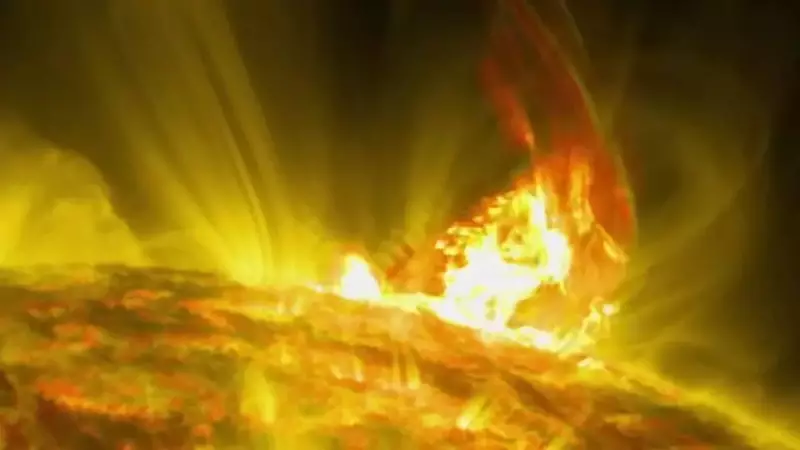
The massive structures observed during the artificial eclipse are known as solar prominences. These formations consist of enormous clouds of ionized gas suspended in the Sun's atmosphere by magnetic forces. While appearing solid, prominences actually comprise superheated particles tracing invisible magnetic field lines.

Solar prominences maintain temperatures around 10,000 degrees Celsius, making them cooler than their immediate surroundings but still vastly hotter than any terrestrial environment. These structures can undergo sudden expansion and eruption, releasing substantial energy and matter into space when underlying magnetic forces become unstable.
This pioneering research represents a significant advancement in solar science, providing scientists with unprecedented tools to study our star's most elusive characteristics. The artificial eclipse technique developed through the Proba-3 mission opens new possibilities for understanding solar phenomena that directly impact Earth's space environment and technological infrastructure.