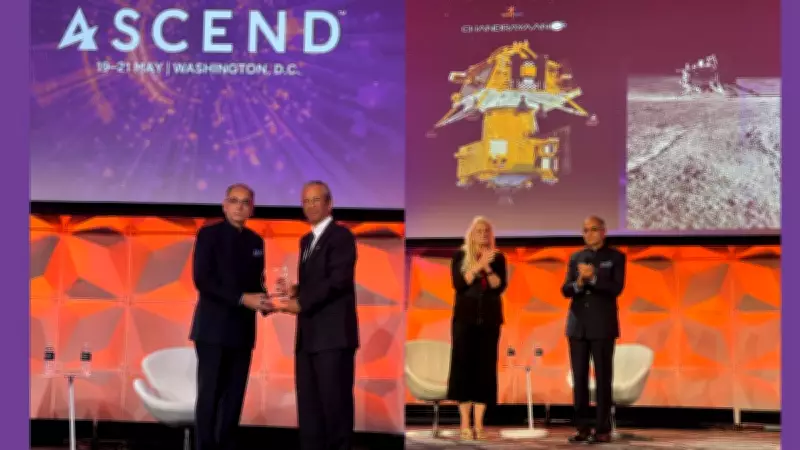
India's Chandrayaan-3 mission has been honored with the 2026 Goddard Astronautics Award, a prestigious recognition presented in the United States for its historic achievement in lunar exploration. The award celebrates the mission's successful soft landing on the Moon's south pole, making India the fourth country to achieve a lunar landing and the first to reach the uncharted southern region.
Historic Achievement Recognized Globally
The Goddard Astronautics Award, named after rocketry pioneer Robert H. Goddard, is one of the highest honors in the field of astronautics. Chandrayaan-3's selection highlights its groundbreaking contribution to space science and technology. The mission, launched by the Indian Space Research Organisation (ISRO), demonstrated remarkable precision and resilience, overcoming challenges to land the Vikram lander and deploy the Pragyan rover.
Scientific Contributions
The mission provided valuable data on the Moon's surface composition, temperature variations, and seismic activity. The Pragyan rover conducted in-situ experiments, confirming the presence of sulfur and other elements, which could support future lunar habitation. These findings have significant implications for understanding the Moon's geological history and resource potential.

International Collaboration and Inspiration
The award ceremony, held in Washington D.C., was attended by ISRO officials, Indian diplomats, and global space leaders. In his acceptance speech, ISRO Chairman Dr. S. Somanath dedicated the award to the Indian scientific community and the nation's youth. The mission has inspired a new generation of scientists and engineers, reinforcing India's position as a major spacefaring nation.
Chandrayaan-3's success has also strengthened international partnerships, with several countries expressing interest in collaborating on future lunar missions. The award underscores the growing recognition of India's capabilities in space exploration and its commitment to peaceful scientific advancement.