China Dismisses Free and Open Indo-Pacific as Contrary to Regional Goals
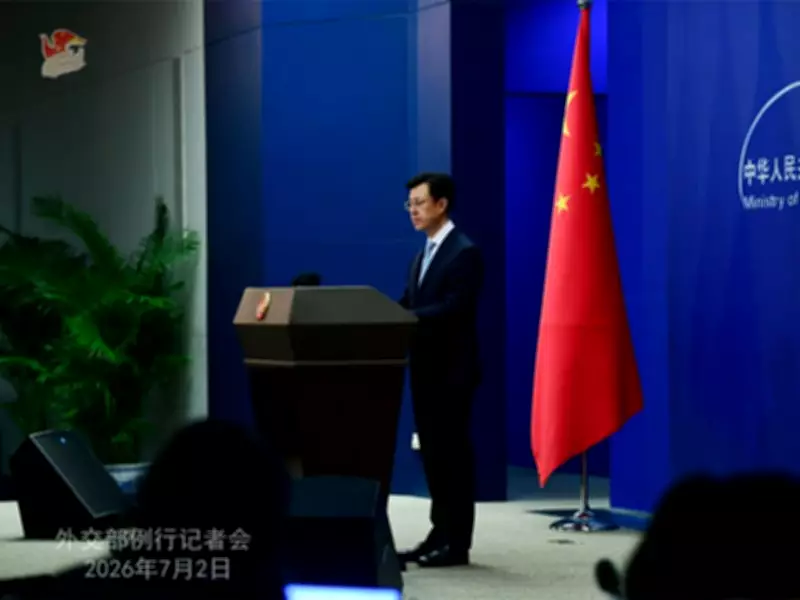
Beijing has firmly rejected the concept of a "Free and Open Indo-Pacific" (FOIP), asserting that it contradicts the shared aspirations of countries in the region for peace, development, and cooperation. The statement was made by Chinese Ministry of Foreign Affairs Spokesperson Guo Jiakun, as shared by Yu Jing, Spokesperson of the Chinese Embassy in India, via a post on X on July 3, 2026.
Guo emphasized that safeguarding the postwar international order and the purposes and principles of the United Nations Charter is fundamental to the prosperity and stability of the Asia-Pacific region. He called on regional countries to uphold the correct path of Asia-Pacific cooperation and work together to build a prosperous, stable, open, interconnected, universally beneficial, inclusive, united, and mutually supportive Asia-Pacific.
Yu Jing Amplifies China’s Stance on X
In a detailed post on X, Yu Jing wrote, "Spokesperson of MFA: The so-called concept of 'Free and Open Indo-Pacific' goes against the regional countries’ shared aspirations for peace, development and cooperation, and will never win genuine recognition. Safeguarding postwar international order and purposes and principles of the UN Charter is the foundation of the prosperity and stability in the Asia Pacific, as well as the shared responsibility of regional countries. It is more imperative than ever for regional countries to uphold the right course of Asia-Pacific cooperation, work together to build an Asia Pacific that is prosperous, stable, open, interconnected, universally beneficial, inclusive, united and mutually supportive."

This critique comes amid growing international discourse on maritime security and regional cooperation frameworks, particularly in the Indian Ocean and Pacific regions.
Japan’s Sanae Takaichi Aligns with India’s MAHASAGAR Initiative
In a separate development, Japanese Prime Minister Sanae Takaichi on Thursday expressed alignment between India’s MAHASAGAR (Mutual and Holistic Advancement for Security and Growth Across Regions) policy and Japan’s Free and Open Indo-Pacific strategy. Speaking alongside Indian Prime Minister Narendra Modi, Takaichi stated that both leaders agreed to deepen strategic cooperation to achieve common goals.
"Prime Minister Modi positions the ocean as a shared space that supports regional stability and growth and is promoting the MAHASAGAR, the Great Ocean Initiative for countries across the Indian Ocean to defend their sovereignty and the sea through their own efforts, which is perfectly aligned with FOIP," Takaichi said during a press briefing. She added, "Thus, we agreed to deepen the strategic cooperation between Japan and India to achieve such common goals. Expansion of maritime security cooperation is especially important for regional peace and stability."
Contrasting Visions for Regional Order
China’s rejection of the FOIP concept highlights the divergent approaches to regional order between Beijing and the U.S.-led alliance system. While China advocates for a postwar international order centered on the UN Charter, Japan and India promote a rules-based maritime order that emphasizes freedom of navigation and sovereignty. The FOIP framework, initially proposed by Japan and later adopted by the United States, aims to ensure a free and open maritime space from the Indian Ocean to the Pacific. China, however, views this as a containment strategy that undermines its interests and regional stability.
The Chinese statement also underscores a call for regional countries to resist external influence and instead focus on cooperation that is inclusive and mutually beneficial. As the Asia-Pacific region continues to experience geopolitical shifts, the debate over the Indo-Pacific concept remains a central point of contention among major powers.
According to analysts, the differing positions could complicate multilateral discussions on maritime security, trade routes, and regional governance. The Chinese embassy’s remarks are likely to be closely monitored by other regional players, including ASEAN member states, which have traditionally sought to balance relations with major powers.