

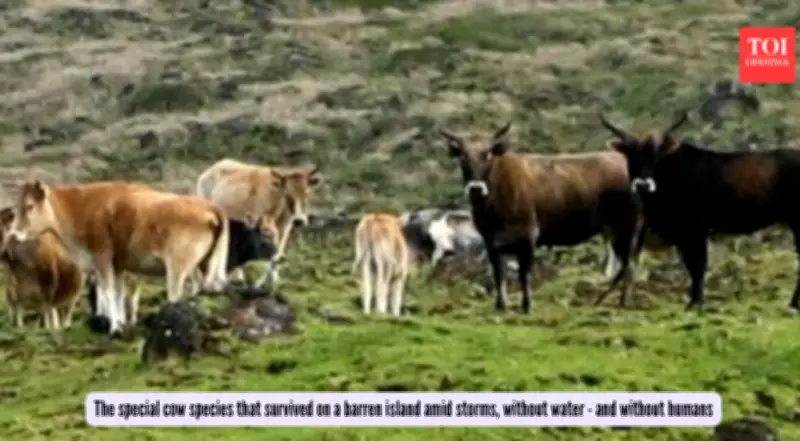
The Incredible Survival Story of Amsterdam Island's Feral Cattle
Animal species typically thrive only when provided with adequate food sources and optimal environmental conditions. However, nature occasionally presents extraordinary exceptions that defy conventional biological wisdom. One such remarkable case exists on a remote, windswept island in the vast expanse of the Southern Indian Ocean, where domestic animals not only survived but flourished under seemingly impossible circumstances.
A Hostile Environment That Should Have Been Inhospitable
Amsterdam Island, situated approximately 4,440 kilometers southeast of Madagascar, presents conditions that appear fundamentally incompatible with large mammal survival. Comparable in size to France's Noirmoutier Island, this isolated landmass battles relentless winds throughout the year, experiences heavy winter rainfall, and critically lacks permanent freshwater sources. The combination of these factors creates an environment where life, particularly for large herbivores, should theoretically struggle to persist.
Despite these formidable challenges, this subantarctic territory became home to an unexpected population of cattle for more than a century. The island's transformation into a viable habitat for these animals represents one of nature's most surprising adaptations.

Historical Origins: From Domestic Livestock to Wild Population
The remarkable journey of these cattle began with French farmer Heurtin from Réunion Island. In January 1871, Heurtin and his companions attempted to establish a settlement on the uninhabited 55 square kilometer island. They brought with them sheep, various crops, and approximately five to six cows, hoping to create a sustainable agricultural outpost.
After seven months of fruitless effort, the settlers abandoned their venture on August 19, 1871, leaving their livestock behind. Against all expectations, these abandoned animals not only survived but underwent a process of feralization, adapting to their new environment without any human assistance. According to a comprehensive study conducted by D. Berteaux and T. Micol of the Centre d'Études Biologiques de Chizé, the initial handful of cattle multiplied dramatically, reaching a population of nearly 2,000 individuals by the late 1980s.
Extraordinary Adaptations for Extreme Survival
The cattle of Amsterdam Island developed remarkable physiological and behavioral adaptations that enabled their survival in this challenging environment. Researchers observed that the animals evolved smaller body sizes compared to their domestic ancestors, along with distinctive horn lengths and unique coat coloration patterns. These changes likely represented evolutionary responses to the island's limited resources and specific environmental pressures.
Perhaps most astonishing was their adaptation to the island's water scarcity. As noted in scientific studies, these cattle developed unusual adaptations related to water economy that eliminated their need for supplementary freshwater sources. The animals learned to lick dew from vegetation and even dig pits to access moisture, demonstrating exceptional behavioral flexibility.
Their prolonged isolation created a genetically unique population - one of the world's few truly European-origin cattle populations that had become completely wild through natural selection processes.
Ecological Impact and Conservation Measures
By the 1980s, the growing cattle population began to exert significant pressure on the island's fragile ecosystem. The animals consumed substantial amounts of vegetation, putting rare native species at risk, particularly the endangered Amsterdam albatross. Conservation authorities recognized the need for intervention to protect the island's biodiversity.
In 1987, a decisive conservation measure was implemented: a 4-kilometer fence was constructed across the island. South of this barrier, authorities conducted controlled culling operations between 1988 and 1989, removing 1,059 cattle from the ecosystem. The remaining population continued to provide meat for the scientific research station that had been established on the island in 1949.

Ecosystem Recovery Following Population Management
The ecological benefits of these conservation efforts became evident over subsequent decades. Following the removal of cattle from the fenced section, scientists returning in 2007 observed significant environmental recovery. Areas that had been bare and overgrazed began regenerating with native grasses, ferns, and shrubs in locations inaccessible to the remaining cattle.
The most dramatic recovery was witnessed in the Amsterdam albatross population. From a precarious low of just five nesting pairs in 1983, the population rebounded to 51 nesting pairs by 2018. Additionally, unique Phylica arborea shrubs, which had been threatened by grazing pressure, began to recover across the island.
This remarkable case study demonstrates both the incredible adaptability of domestic animals when returned to wild conditions and the resilience of natural ecosystems when given opportunity for recovery. The story of Amsterdam Island's cattle serves as a powerful testament to nature's capacity for both adaptation and regeneration under the most challenging circumstances.





