There are five species of snake on this planet that can launch themselves off a tree branch, flatten their body into something resembling a ribbon, and glide through the air with enough control to steer between trees, dodge obstacles, and land without injury. They have no wings. They have no limbs of any kind. They have none of the physical equipment that any rational assessment of aerodynamics would suggest is necessary for flight. And yet researchers who have studied them in slow-motion footage, in wind tunnels, and from 30-metre-high experimental platforms have arrived at the same conclusion: the flying snake is genuinely good at this. Not passably good. Not adequate for short distances. Genuinely, surprisingly, scientifically impressive, capable of gliding up to 100 metres through a forest canopy, turning in mid-air, maintaining stability throughout, and touching down without a scratch. They belong to the genus Chrysopelea, they live across South and Southeast Asia, including India and Sri Lanka, and they are one of the more extraordinary things that evolution has quietly produced whilst nobody was paying attention.
What flying snakes actually are and where they live in South and Southeast Asia
The genus Chrysopelea contains five recognised species, all found across a range stretching from western India through Sri Lanka, Bangladesh, Myanmar, Thailand, Vietnam, southern China, the Philippines, and the Indonesian archipelago. They are slender, arboreal, and active by day, spending most of their lives in the forest canopy hunting lizards, frogs, small bats, and occasionally birds. They are mildly venomous, but their venom is adapted for subduing small prey and is not considered dangerous to humans. Bites may cause localised pain, swelling, and mild discomfort, but serious medical complications are extremely rare.
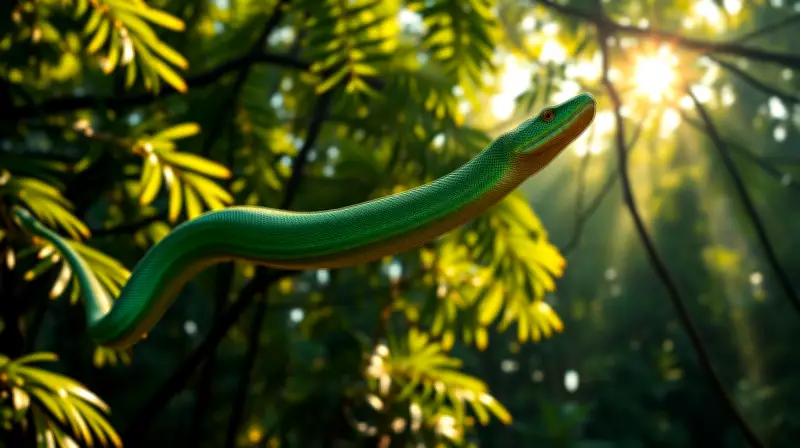
The species most likely to be encountered in India is the golden tree snake (Chrysopelea ornata), which ranges across India and Sri Lanka and can grow up to 130 centimetres. It is typically black or greenish with yellow or reddish flower-shaped markings, its head banded with yellow crossbars. The most extensively studied species globally is the paradise tree snake (Chrysopelea paradisi), found across Southeast Asia, including parts of northeastern India, black and vivid green with distinctive orange diamond markings. Sri Lanka additionally has its own endemic species, Chrysopelea taprobanica, which is the least studied of the five and closely resembles the golden tree snake in appearance. All five species share the same core gliding mechanism, differing primarily in size, range, and colouring.

How the flying snake launches, flattens its body, and generates lift without wings
The launch sequence of a flying snake is precise and deliberate, not a panicked leap but a calculated departure. The snake climbs using specialised ridge scales along its underside that grip rough tree bark, moving vertically until it reaches the end of a branch. Once there, it continues until its tail is the only part still making contact. It then forms a distinct J-shaped bend with its body, pauses briefly, identifies a landing area, and goes.
As it becomes airborne, the body transforms entirely. Every rib spreads outward simultaneously, flattening the normally cylindrical snake into something almost ribbon-thin, a cross-sectional shape that is roughly triangular, with a concave underside and small lateral lips protruding on either side. This concave profile functions as a wing, generating lift as air moves beneath it. The head remains relatively stable throughout, while the rest of the body begins a complex three-dimensional undulating motion, S-shaped waves travelling from head to tail in the horizontal plane, with the posterior end also oscillating vertically.
It is this undulation that researchers at Virginia Tech, publishing in the Journal of Experimental Biology in 2024, identified as the key to the snake's stability in flight. Remove the undulation, and the glide becomes unstable. Keep it, and the snake stays level, manoeuvrable, and in full control of its trajectory.

How far flying snakes can glide and why their performance outstrips theoretical predictions
The figures, stated plainly, are remarkable for a limbless animal. The paradise tree snake regularly achieves controlled glides of up to 30 metres, and Britannica records glides of up to 100 metres for the genus under optimal height and conditions, making flying snakes competitive with flying squirrels, which are widely considered among the best gliders in the animal kingdom, and far exceeding what any theoretical model would predict for a body with no wings.
The minimum recorded glide angle is 13 degrees, meaning the snake travels roughly 4.4 metres forward for every 1 metre it descends at its shallowest trajectory. It can also turn in mid-air, a capability documented with motion-capture equipment. Crucially, the Virginia Tech researchers found that their theoretical models consistently under-predicted the actual glide performance of these snakes, suggesting the aerodynamic contribution of the undulating body is more significant than any current model has fully accounted for.
Why flying snakes evolved this ability and what research has not yet explained
The most likely explanation for why these snakes glide at all comes down to efficiency and escape. Gliding across a gap between trees costs far less energy than descending to the ground, crossing the gap, and climbing back up. In a dense forest canopy, ground-level travel also exposes the snake to a different set of predators. The ability to glide allows fast, safe movement through the canopy without ever touching the forest floor and provides an immediate escape route when threatened.
The undulation was initially assumed by researchers to be a default motor pattern carrying over from ground movement. The 2024 Virginia Tech study showed it is something more purposeful than that. Experiments found the undulation actively stabilises the glide, preventing rolling and keeping the snake level throughout. It is not simply a terrestrial behaviour repurposed for the air, it is a specific in-flight adaptation that evolved to make gliding work better.
Two fundamental questions about flying snake aerodynamics remain unanswered. Researchers understand that the undulation provides stability, but do not yet fully understand exactly how the flattened body generates lift, nor the precise mechanics of mid-air turning. The 2024 Virginia Tech paper was directed specifically at closing the first of these gaps using higher-resolution kinematic analysis than any previous study. Its conclusion that standard aerodynamic theory consistently under-predicts what these snakes achieve means the snakes are doing something the models have not yet fully captured. For an animal with no wings, no legs, and no apparent reason to be in the air at all, the flying snake continues to be considerably more interesting than it has any right to be.