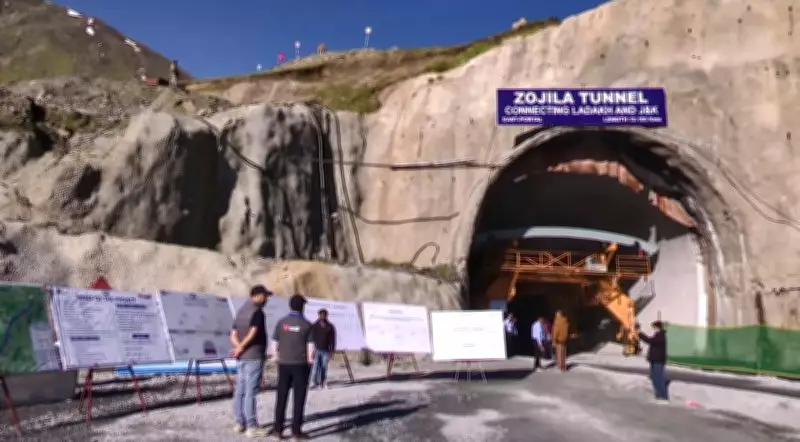
Union Minister Nitin Gadkari triggered the final blast marking the breakthrough of the Zojila Tunnel near its east portal at Minimarg in Ladakh on Tuesday. Amidst missiles raining from the sky back home, Iranian Engineer Yousef Es'haghpour Rahimabadi remained focused on the high-altitude project that will keep the people of Ladakh and Jammu and Kashmir connected throughout the year.
Playing a pivotal role in the construction of the Zojila tunnel thousands of miles away from the conflict engulfing his homeland, Rahimabadi had to battle extremely harsh winters, heavy snowfall, and difficult terrain. Rahimabadi, who studied and married in India, calls India his second home. When the ambitious Zojila Tunnel project achieved a breakthrough on Tuesday, he beamed with joy and pride, describing the breakthrough as a very big milestone.
Role and Challenges
The Iranian engineer, currently the Authority Engineer for the Zojila Tunnel project, said it was an honour to work on such an iconic project. 'I am from Iran. I work on the Zojila Project. It is a great honour to work on this project. It is an iconic project, and a national pride,' Rahimabadi said. 'There were lots of challenges, but we executed it successfully,' he added, noting it would take another 2-2.5 years to complete the remaining work and open the tunnel for the public.

Rahimabadi is the team leader of a joint venture of Intercontinental Consultants and Technocrats Private Limited (ICT) and Anadjiwala Infra Advisory Private Limited (AIAPL), the supervising engineers overseeing the project. Hyderabad-based Megha Engineering and Infrastructure Limited is constructing the tunnel.
Engineering Marvel
A key man and a familiar face, Rahimabadi spent months overseeing one of the country's most ambitious and challenging infrastructure projects. 'We had minus 35 degrees Celsius temperatures this side. The terrain is very difficult. There are road closures. The Zojila Pass remains cut off due to heavy snow. 11.5 million man-hours is not a joke. In such a challenging project, we don't have even a small casualty or anything. It is the most safe project,' he added.
Studied and married in India, Rahimabadi, whose primary role in the project is supervision and design control, said the tunnel is not just an engineering marvel but a vital bridge that will provide all-weather connectivity between Kashmir and Ladakh. 'This is the most strategic tunnel. It will give all-weather connectivity between Kashmir and Ladakh,' he said, adding that in times of emergency, defence forces would be able to use the tunnel.
Comparison and Timeline
When asked if India's engineering was at par with China's, the engineer said, 'I think we are a little bit ahead (of them), for this project especially.' 'I have visited just one tunnel project in China. This project is much more iconic so far in my life span,' he said. About the ongoing work on the Zojila Tunnel, Rahimabadi said most of the civil work has been done. 'Heading work is being done. Some little benching and shaft work is left. We will complete it within the stipulated timeframe and in the next 2 to 2.5 years, we will be able to hand over this project,' he said. The project, which started in 2020, was originally targeted to be completed in eight years, but thanks to improved planning and hard work, the time has been significantly reduced, the Iranian engineer added.