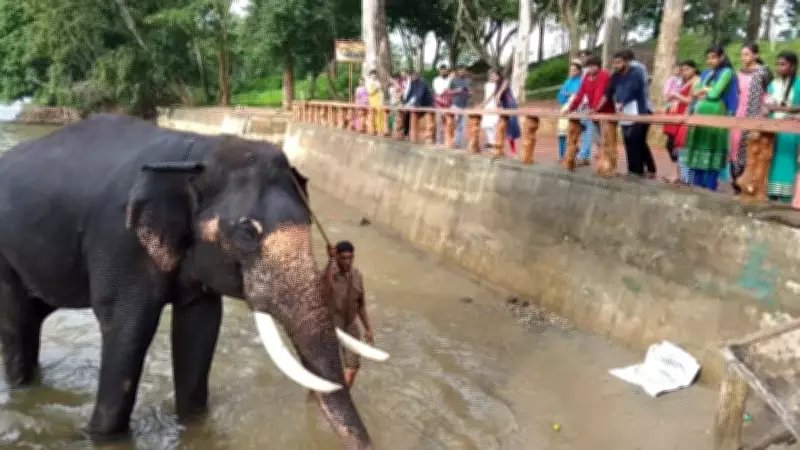
In the wake of a tragic incident at the Dubare elephant camp in Kodagu district, where a tourist lost her life during a clash between two captive elephants, the Karnataka forest department has imposed stringent restrictions on tourist interactions with captive elephants across all 14 elephant camps in the state. The new measures include a complete ban on feeding, bathing, and taking photographs with elephants from close quarters.
New Safety Measures Enforced
Forest Minister Eshwar Khandre on Monday directed officials to immediately enforce a minimum safety distance of 100 feet between tourists and elephants at all camps. Tourists will now only be permitted to watch elephants bathe from designated viewing zones. The minister has also ordered the preparation of a comprehensive Standard Operating Procedure (SOP) for visitor safety at elephant camps, similar to the recently introduced safety guidelines for eco-tourism trekking trails in the state. Officials have been instructed to prioritize crowd management and regulate tourist movement around captive animals.
The Fatal Incident
The restrictions come just hours after a 33-year-old tourist from Chennai lost her life in a freak incident at the popular Dubare elephant camp near Kushalnagar in Kodagu district. The woman died after getting trapped under an elephant during a sudden fight between two captive tuskers, Kanchan and Marthanda, while tourists were participating in elephant bathing activities in the Cauvery river. Describing the incident as “deeply shocking and unfortunate,” Khandre said the tragedy underscored the unpredictable nature of wildlife, even when animals are trained and kept in captivity for years.

“Understanding the behavior of elephants and other wildlife is extremely difficult. Their instincts remain intact despite training. Henceforth, tourists should not touch elephant trunks, stand beside elephants for photographs, bathe them or feed them bananas, jaggery or sugarcane,” the minister said.
Official Directives and Inquiry
Kumar Pushkar, Principal Chief Conservator of Forests and Chief Wildlife Warden, said the new directives would fundamentally change how elephant camps function across Karnataka. “As per the new directions, tourists will only be allowed to observe elephants from a safe distance. Any direct physical interaction with the animals will be completely prohibited,” Pushkar said. He added that the department has ordered an inquiry to ascertain the exact sequence of events that led to the fatal incident at Dubare and identify any possible lapses.
Concerns Over Commercialization
The incident has also revived concerns among wildlife conservationists over growing commercialization and overcrowding at elephant camps and eco-tourism sites. Sanjay Gubbi of Holematthi Nature Foundation said close-contact wildlife tourism posed serious risks both to humans and animals. “These are wild animals and their behavior can be unpredictable. Excessive tourism and overcrowding make it difficult for mahouts and officials to enforce safety protocols. Such close-contact tourism involving wildlife should be stopped immediately,” he explained.
Previous Case of Aggression
The aggressive behavior displayed by elephant Kanchan at Dubare Monday was not an isolated incident. The tusker had earlier made headlines during the world-famous Mysuru Dasara celebrations in 2024 after a tense altercation with another elephant, Dhananjaya, near the Mysore Palace premises. The situation had triggered panic among devotees and tourists after Kanchan broke free from the enclosure while trying to evade Dhananjaya’s attack. The elephant reportedly ran amok for a brief period, damaging steel barricades and sending the festive crowd into a state of panic.

Elephants Not in Musth
Amid rumors that the two elephants involved in the Dubare incident were in musth — a periodic condition in male elephants marked by a surge in reproductive hormones and heightened aggression — forest officials clarified that neither Kanchan (tusker) nor Marthanda (Makhna, a male without tusks) was undergoing the phase. Madikeri DCF Abhishek said both elephants were not in musth at the time of the incident. Chief Wildlife Warden Kumar Pushkar also stated that three other elephants at the camp that were in musth had been isolated at a separate facility and were not brought to the tourist area. However, preliminary findings suggest that Marthanda may have been preventing Kanchan from approaching a female elephant, possibly triggering the aggressive behavior.