

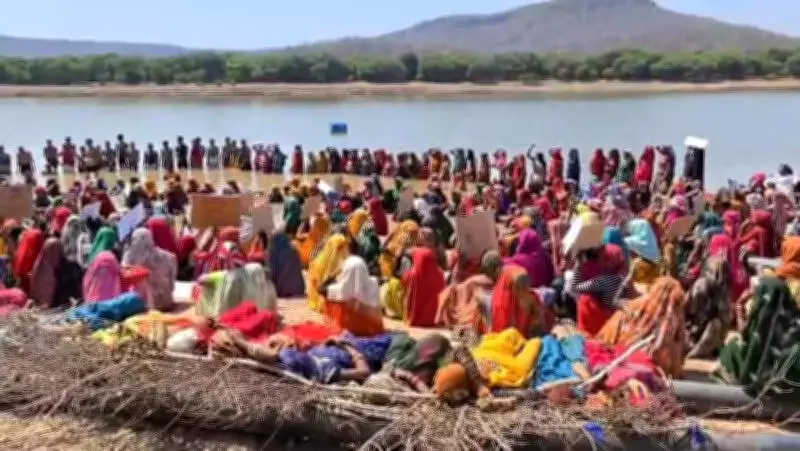
After nearly two weeks of standoff between tribal residents of Chhatarpur and Panna and authorities, protests over the Ken-Betwa river-linking project were temporarily suspended on Friday. This followed the initiation of a fresh survey into alleged irregularities in compensation and rehabilitation in 14 affected villages.
The protests escalated from symbolic acts to direct action. Tribal women began the agitation on April 5 by lying on mock funeral pyres in the 'chitta andolan.' This was followed by men smearing soil over their bodies in 'mitti andolan' and protesters entering the river in 'jal andolan.' Demonstrators also tied symbolic nooses around their necks, chanting 'Give us justice or death.'
One female protester at the Ken River said, 'Our houses were snatched away and we did not get adequate compensation. What should we do? If we get a hearing and justice, you can build all the dams and canals.'

Background of the Project
The Ken-Betwa project aims to transfer surplus water from the Ken River to the Betwa River via a 221 km canal from the Daudhan Dam. It is intended to provide irrigation and drinking water to drought-prone districts in Madhya Pradesh and Uttar Pradesh. The state government has described it as a game-changer for the Bundelkhand region.
However, environmentalists and critics highlight significant costs. Estimates suggest the project will displace 6,600 families and cut down nearly 45 lakh trees. In 2017, the forest advisory committee recommended against clearance, stating, 'Ideally, this project should not be given clearance.'
Objections Over Time
River researcher Himanshu Thakkar contested the claim of surplus water in the Ken River, filing a petition in the National Green Tribunal in 2017. Rajendra Singh, known as the Waterman of India, criticized the project, saying, 'Any big development project begins with displacement of the underprivileged. Small community steps like rainwater harvesting would have been better and less costly.'
Shashi Shekhar, a former secretary of the Ministry of Water Resources, argued in 2025 that the region's hydrology does not justify such a large project. He also noted that objections from a Supreme Court-appointed committee were ignored.
A TOI report from March 31, 2021, noted that after the memorandum of agreement between Madhya Pradesh and Uttar Pradesh, protesters registered a silent protest during COVID-19, pointing to 23 lakh trees to be cut and submergence of parts of the Panna Tiger Reserve. The National Tiger Conservation Authority's 2022 report warned that a substantial portion of the biodiverse reserve is under threat from submersion.
Recent Wave of Protests
In the latest protests, displaced tribal villagers and farmers from Panna and Chhatarpur demanded proper compensation and rehabilitation. Authorities issued prohibitory orders under Section 163 of the BNS, but protesters moved to the middle of the Ken River. Officials claim protesters are being misled about compensation packages.
Authorities state that families directly displaced by the Ken-Betwa project are eligible for Rs 12.5 lakh, while those affected by separate state irrigation projects get Rs 7.5 lakh. Despite this, 200 tribal protesters breached the core area of the Panna Tiger Reserve, baffling the forest department.
The Way Ahead
The project's future depends on addressing displacement, rehabilitation, and environmental concerns while balancing developmental goals. Clear and fair communication with affected communities is essential; otherwise, the project may fail to serve the region as intended.






