

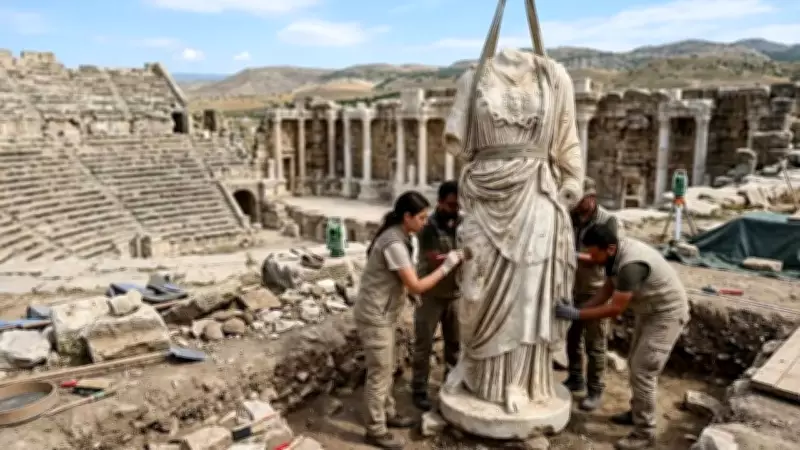
A marble statue of the Greek goddess Athena has been excavated from the ruins of the ancient city of Laodicea in Denizli Province, Turkey. The statue, made of white marble and standing approximately 2 meters tall, was discovered lying face down among debris near the postskene of the Western Theatre, according to the Turkish Ministry of Culture and Tourism.
Historical Significance of the Discovery
The statue is considered an outstanding example of Roman-era sculpture. Although the head has not been recovered, archaeologists believe it represents an important depiction of the cultural and religious beliefs of the ancient world. Laodicea was one of the most prosperous regions for weaving and trade in antiquity.
Architectural Context
The statue originates from the stage building of the Western Theatre, an architectural structure dating to the 2nd century BC. The theatre features three floors, each with 16 columns, forming a backdrop for sculpted scenes from Homeric epics, including the Land of the Laestrygonians, Polyphemus' cave, and the sea monster Scylla.

The statue depicts Athena standing on a round base, wearing a finely crafted sleeveless peplos with a hylamis (cape) draped over her shoulders. The aegis on her chest is uniquely carved with the head of Medusa and serpents. Designed to occupy a space between two architectural columns, the statue has an unfinished back, typical of monumental sculptures in theatres and amphitheatres. The distinctive design of the hylamis adds significant archaeological value due to its uncommon style around the neck.
Chronological Dating and Historical Context
Art historians date the piece from the first classical style to the Augustan period (27 BC–14 CE). The discovery reinforces Laodicea's importance as a major center for trade and textile production. While Athena is widely recognized as a goddess of warfare, epigraphic evidence from the site suggests she was primarily worshipped in Laodicea in relation to weaving and handicraft. Inscriptions confirm that her festivals honored these vital local industries. Restoration work at the site has been ongoing since early 2026.






