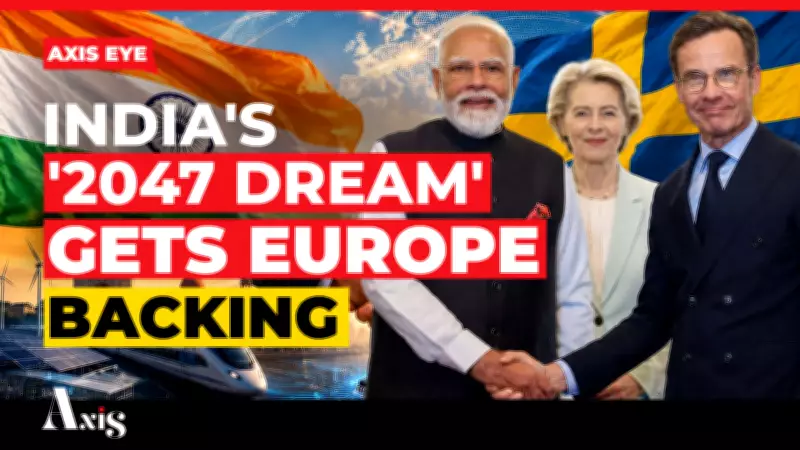
Swedish Prime Minister Ulf Kristersson stood beside Prime Minister Narendra Modi in Gothenburg and made a remarkable announcement — Sweden wants to be a partner in India's 2047 vision. European Commission President Ursula von der Leyen joined them and called the India-EU Free Trade Agreement the mother of all deals. This moment in Sweden was not merely a photo opportunity; it signified Europe placing a strategic bet on India in a world reshaped by the Russia-Ukraine war, the unpredictability of Donald Trump, and China's growing dominance of global supply chains.
Strategic Partnership Elevated
India and Sweden elevated their ties to a full Strategic Partnership, complete with a joint action plan extending to 2030. The agenda covers a wide range of critical areas including semiconductors, artificial intelligence, green hydrogen, 6G telecommunications, defence manufacturing, critical minerals, and space exploration. The newly established Sweden-India Technology and AI Corridor, known as SITAC, directly connects the tech ecosystems of both countries, fostering innovation and collaboration.
Trade Growth and Future Goals
Bilateral trade between India and Sweden has already jumped from $2.8 billion to $7.8 billion. Prime Minister Kristersson now aims to double this figure within five years, reflecting the deepening economic ties. This growth underscores the mutual commitment to enhancing economic cooperation and leveraging each other's strengths.

Geopolitical Context
The strengthening of India-EU relations comes against a backdrop of significant geopolitical shifts. The Russia-Ukraine war has prompted Europe to diversify its partnerships, while Trump's unpredictable foreign policy has led to a reassessment of alliances. Additionally, China's increasing control over global supply chains has made it imperative for Europe to seek reliable partners like India. Europe has chosen India as a key ally, and this partnership is a tangible outcome of that strategic decision.
The India-EU Free Trade Agreement, described as the mother of all deals, is expected to further boost economic integration and create new opportunities for businesses on both sides. The agreement aims to reduce tariffs, streamline regulations, and enhance market access, benefiting a wide range of sectors from technology to agriculture.
Implications for the Future
This partnership positions India as a crucial player in Europe's future economic and technological landscape. With a focus on cutting-edge technologies and sustainable development, the collaboration is set to drive innovation and growth. The joint action plan up to 2030 provides a clear roadmap for cooperation, ensuring that both nations can achieve their shared goals.
As the world navigates through complex geopolitical challenges, the India-EU partnership stands as a beacon of stability and progress. The commitment to work together on critical issues like climate change, digital transformation, and defence security highlights the depth of this new alliance. Sweden's backing of India's 2047 vision is a testament to the trust and mutual respect between the two nations, setting the stage for a prosperous future.