Thailand's 2026 General Election: A Critical Three-Way Contest
Thailand is poised for a pivotal general election on February 8, 2026, marking the latest chapter in the nation's turbulent political landscape. This election represents a fierce three-way battle among progressive, populist, and conservative factions, each vying for control in a deeply divided political environment. The outcome will significantly shape Thailand's future governance and reform trajectory.
Opinion Polls Favor the Progressive People's Party
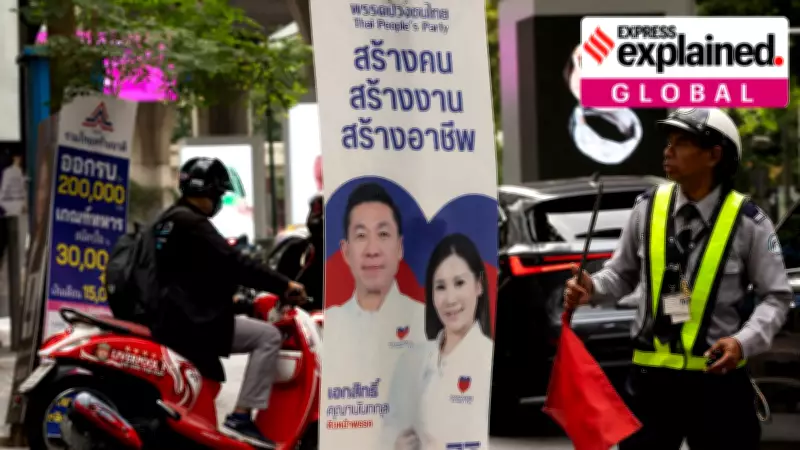
Recent opinion surveys consistently indicate that the progressive People's Party remains Thailand's most popular political entity. With an ambitious reform agenda and exceptional social media prowess, the party has captured substantial support among young and urban Thai voters. Its predecessor, Move Forward, secured a decisive victory in the 2023 election, winning all but one of Bangkok's 33 seats and making notable inroads into traditional conservative strongholds.
Despite this electoral success, Move Forward faced parliamentary hurdles that prevented government formation, even after forming an alliance with the second-placed Pheu Thai party. Current polling data suggests the People's Party has maintained its momentum. A Suan Dusit University poll conducted from January 16 to 28, 2026, involving 26,661 respondents, showed 36% support for the People's Party, with Pheu Thai at 22.1% and Prime Minister Anutin Charnvirakul's Bhumjaithai party at 18.9%.

Another survey by the National Institute for Development Administration, covering 2,500 people from January 23 to 27, revealed 34.2% backing for the People's Party, while Bhumjaithai received 22.6% and Pheu Thai 16.2%. In the 2023 election, Move Forward won 151 of 500 parliamentary seats, Pheu Thai secured 141, and Bhumjaithai obtained 71 seats.
Government Formation Challenges and Coalition Dynamics
The election is unlikely to produce an outright majority for any single party, making coalition-building essential for government formation. This process presents considerable difficulties due to historical animosities and ideological divisions among the major parties. Recent months have witnessed betrayals and significant political fallouts that complicate potential alliances.
Partnerships with smaller parties could prove decisive in breaking parliamentary deadlocks, meaning the party with the most seats might not ultimately lead the government. While the People's Party demonstrates strong electoral appeal, its ability to form a coalition remains uncertain. Bhumjaithai's leader, Anutin Charnvirakul, emerges as a skilled negotiator willing to collaborate across party lines, potentially backed by influential conservative forces outside formal politics.
Pheu Thai, historically dominant and controlled by the billionaire Shinawatra family, possesses substantial financial resources despite experiencing defections to Bhumjaithai and declining popularity. Many analysts speculate that Pheu Thai might partner with Bhumjaithai to establish a government, replicating previous political arrangements.
Obstacles Confronting the People's Party
Although the People's Party appears to hold an electoral advantage, its liberal, anti-establishment platform and commitment to institutional reform present significant barriers. The party's popularity and policy proposals—including tackling monopolies and reforming military and judicial institutions—threaten Thailand's longstanding status quo and challenge powerful business elites, royalist generals, and established interest groups.
The party's political journey has been marked by legal challenges. Its earlier incarnation, Future Forward, was dissolved by court order in 2020 over campaign finance violations, sparking widespread street protests. Rebranded as Move Forward, it won the most votes in 2023 but was blocked from forming a government by army-appointed senators and later dissolved for advocating changes to laws protecting the monarchy.

Now operating as the People's Party, the group faces ongoing legal scrutiny. The National Anti-Corruption Commission is investigating 44 former Move Forward lawmakers, including 15 current People's Party members, for alleged ethics breaches related to attempts to amend royal insult laws in 2021. Among those under investigation are two of the party's three prime ministerial candidates, leader Natthaphong Ruengpanyawut and deputy leader Sirikanya Tansakun. If referred to the Supreme Court, they could face political bans.
Anutin Charnvirakul's Political Prospects
Prime Minister Anutin Charnvirakul, aged 59, represents political pragmatism with a party sufficiently large to negotiate key ministerial positions in coalition governments. A staunch royalist who has strategically positioned himself between rival political clans, Anutin demonstrated his political acumen by swiftly ascending to the premiership in September 2025 after a court dismissed then-Prime Minister Paetongtarn Shinawatra.
Anutin successfully lobbied parties to abandon her coalition and support his leadership instead. To secure another term, he must expand Bhumjaithai's parliamentary presence beyond its current 71 seats and leverage his establishment connections to form an alliance capable of countering the People's Party's influence.
Prime Minister Selection Process
Political parties contesting the election have submitted up to three prime ministerial candidates. Any party holding at least 25 parliamentary seats can nominate a candidate for a parliamentary vote. Securing the premiership requires support from more than half of the 500-member lower house. If the initial candidate fails, the house reconvenes to consider other nominees until a prime minister is elected, with no time restrictions on this process.
Thailand's 2026 election thus represents not merely an electoral contest but a complex political maneuver involving legal challenges, coalition negotiations, and deep-seated ideological conflicts that will determine the nation's governance direction for years to come.