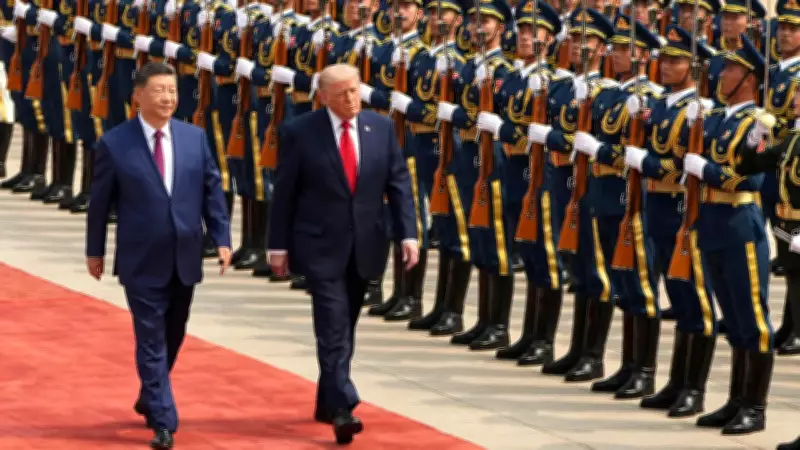
US President Donald Trump appeared notably subdued during his visit to Beijing, where Chinese President Xi Jinping orchestrated a grand ceremonial display. Rows of Chinese soldiers stood in perfect formation, red carpets stretched across the Great Hall of the People, and children waved flags. The precision, discipline, and power on display left Trump, known for his boastful rhetoric about the American military, expressing admiration mixed with recognition of China's growing military capabilities.
Changing Global Power Dynamics
For decades after the Soviet Union collapsed in 1990, Washington stood alone at the peak of global power. However, Beijing's message was clear: that era may be changing. Trump repeatedly praised Xi as a "great leader," but behind the warm words lay a deeper undercurrent. The visit was not merely a state visit; it was a showcase of China's confidence in military, technological, and geopolitical domains.
Taiwan Tensions
China's messaging on Taiwan turned strikingly blunt during the visit. Chinese officials warned that US involvement in Taiwan-related matters could "lead to US-China conflict." Taiwan, a self-ruled island claimed by Beijing but backed by Washington, has become the most dangerous fault line in US-China relations. Taiwan's defence ministry accused China of "military harassment" and grey-zone operations, stating that "Beijing has no right to make any claims on behalf of Taiwan internationally."

China's Role in the Iran Conflict
Beyond Taiwan, the Iran conflict under "Operation Epic Fury" revealed how modern geopolitical battles are evolving. Reports pointed to Chinese technology strengthening Iran's military capabilities. The BeiDou Navigation Satellite System, China's answer to America's GPS, has been used by Iran since 2021 to improve drone accuracy and deploy decoy systems. This signifies that power is increasingly measured through drones, AI systems, cyber capabilities, and satellite navigation.
America's Military Vulnerabilities
The Iran war exposed both strengths and vulnerabilities of the American military. US forces fired thousands of missiles and drones, but the scale of the operation depleted long-range precision munitions stockpiles. A CSIS assessment noted that production timelines for critical weapons remain slow, taking three to four years for some systems. Strategic analysts fear that prolonged conflict could rapidly expose shortages.
China's Wartime Industrial Mindset
China's defence industry operates with a wartime mindset, rapidly producing warships, submarines, missiles, drones, and cyber capabilities. Unlike the United States, China's centralised system allows faster scaling of military production. Modern warfare has shifted toward drones, AI-enabled targeting, and autonomous platforms, where China is moving aggressively.
Taiwan as a Flashpoint
Military planners view Taiwan as the scenario around which future Pacific warfare is modelled. CSIS war-game simulations show US forces exhausting critical long-range missiles within the first week of a Taiwan conflict. China's missile systems now threaten large parts of the Indo-Pacific, including American bases in Japan, Guam, and the Philippines. US aircraft carriers and destroyers are increasingly vulnerable inside China's missile range.
The 'Hellscape' Concept
The Pentagon's emerging concept, "Hellscape," aims to turn the Taiwan Strait into an overwhelming maze of drones, underwater systems, and autonomous weapons. Instead of relying on expensive fighter jets or warships, the strategy focuses on "precise mass"—large numbers of cheaper drones and unmanned systems. The report warned that the US and Taiwan may need hundreds of thousands of drones in any prolonged conflict.
Industrial Capacity as the Decisive Factor
The CSIS report concluded that wars between great powers are ultimately won by industrial capacity. America's historic mobilisation during World War II and the Cold War transformed the country into a defence production giant. However, today, aircraft maintenance problems, overstretched naval deployments, and delayed weapons production point toward a system under strain. The report called for a modern industrial mobilisation effort to accelerate defence manufacturing and strengthen supply chains.

Beneath the diplomatic handshakes in Beijing, the strategic contest is no longer only about who has the stronger military today, but who can sustain the next war tomorrow.