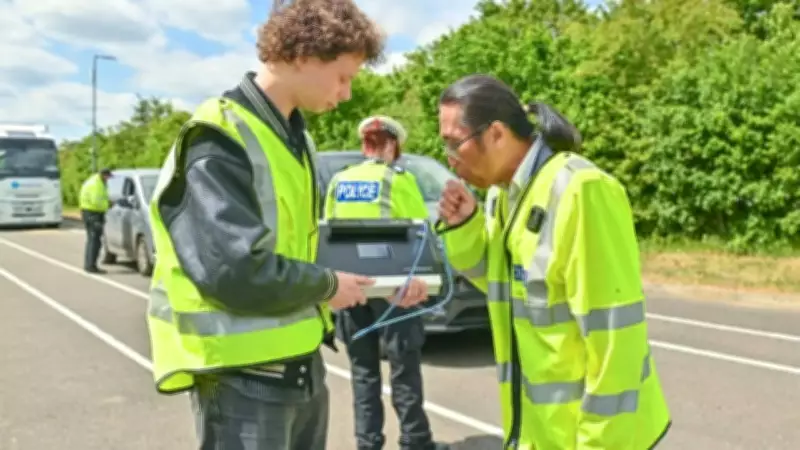
A groundbreaking roadside breath test designed to detect nitrous oxide use is being trialled in southern England, marking what police describe as a significant step in combating drug-driving. The device, believed to be the first of its kind in the world, is being tested by officers in Hampshire and the Thames Valley region amid growing concerns over drivers using laughing gas, also known as NOS. Authorities report that the drug is becoming an increasing issue among young motorists, with its effects posing serious risks on the road.
Pilot programme led by Hampshire and Thames Valley Police
As reported by Sky News, the trial is being led by Hampshire and Isle of Wight Constabulary and Thames Valley Police, who have described nitrous oxide use behind the wheel as an “emerging threat” to public safety. Officers have long struggled to prove impairment from the substance, which has made prosecutions difficult despite growing evidence of misuse. The new handheld device aims to change that by allowing officers to detect recent nitrous oxide use through a simple breath test. Drivers breathe into the portable machine, which provides results within minutes. According to those involved in the trial, the technology can identify whether someone has inhaled nitrous oxide within a window of up to two hours.
Technology developed by Respira Technologies and Vrije Universiteit Amsterdam
The technology has been developed by Respira Technologies following research conducted at Vrije Universiteit Amsterdam. Researchers behind the project say the system has already shown promising accuracy in controlled environments, and the current trial is focused on how it performs in real roadside conditions. Police officers involved in the project say the device could fill a major gap in enforcement. At present, there is no widely available roadside tool capable of confirming nitrous oxide use at the time of driving. In many cases, authorities must rely on indirect evidence such as witness accounts or video footage, which can make it difficult to secure convictions.

Acting Superintendent Emma Hart highlights enforcement challenges
Acting Superintendent Emma Hart, who is involved in the joint operations roads policing unit, said the lack of a reliable detection method has been a long-standing challenge. She explained that the introduction of this technology could potentially strengthen prosecutions for drug-driving offences involving nitrous oxide. She also highlighted that younger drivers appear to be particularly affected by the trend, often without fully understanding the risks involved.
What is laughing gas and why are UK experts warning about road safety risks?
Laughing gas, or hippy crack, scientifically named nitrous oxide, can produce short-term relaxation and laughter, often consumed for recreational purposes. According to police and health experts, this causes effects including dizziness, reduced coordination, slowed reaction times, and in some cases, neurological harm. These effects can be especially dangerous when combined with driving. Several serious road incidents linked to nitrous oxide use have been reported in recent years. One of the most widely reported cases occurred in Oxfordshire in 2023, where three teenagers died in a high-speed crash involving a driver who had inhaled the substance shortly before the collision. The driver was later jailed after admitting to drug use while behind the wheel. Despite the enforcement made in 2023 for the possession of nitrous oxide for up to 2 years, it has remained difficult due to the absence of reliable roadside testing methods, something police hope the new device could help address.
Early testing phase across southern roads
The trial is currently in its early stages and will run for several weeks across selected roads in southern England. Officers will assess the device’s accuracy, reliability, and practical use in everyday policing situations. If successful, it could eventually be considered for wider rollout across the UK. While officials involved in the project have expressed cautious optimism, they also acknowledge that further testing is needed before the device can be fully integrated into standard policing procedures. For now, the focus remains on whether the technology can consistently perform under real-world conditions and withstand legal scrutiny.