

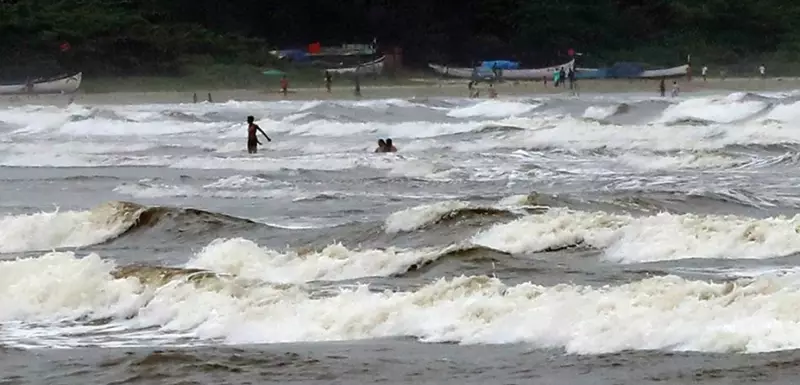
The year 2025 concluded with a familiar yet intense pattern of extreme weather, as the Bay of Bengal churned out four cyclones within a remarkably short span of two months. This activity maintained the north Indian Ocean's long-term annual average of three to four cyclonic storms, mirroring the total count from the previous year, 2024.
A Cluster of Storms in a Record Timeframe
While the beginning of 2025 suggested a quieter cyclone season, the latter part of the year proved otherwise. All four storms—Cyclone Shakti, Cyclone Montha, Cyclone Senyar, and Cyclone Ditwa—developed exclusively in the Bay of Bengal during the post-monsoon season. The latter two, Senyar and Ditwa, formed back-to-back in late October.
"It appears to be a record of sorts. The most interesting factor is that all of them formed in a matter of rarity and that too in a space of two months all in the post-monsoon season," remarked M R Ramesh Kumar, a retired chief scientist at the National Institute of Oceanography (NIO). This clustered formation stands in contrast to the record-breaking year of 2019, which saw eight systems but with longer intervals between them.

The Driving Forces: Warming Oceans and La Nina
Scientists point to a significant environmental driver behind this rapid cyclogenesis: the unprecedented warming of the Indian Ocean. The Indian Ocean is currently the warmest of all global oceans, creating highly favourable conditions for the development and intensification of cyclones.
Adding to this complex weather puzzle is the influence of a large-scale climate phenomenon. "This time, it is a weak La Nina phenomenon that has influenced these four. It is slowly brewing in the eastern equatorial Pacific Ocean near Peru in South America," explained Kumar. The combination of these cyclogenetic conditions likely steered all the storm activity specifically into the Bay of Bengal in 2025.
A Shift in Basin Activity and Long-Term Trends
A notable shift was observed in 2025's storm distribution. Despite a depression in the Arabian Sea in October that affected Goa with cyclonic storm-like conditions, all named cyclones formed in the Bay of Bengal. This is interesting given the increased activity noted in the Arabian Sea since 2019. Over the past seven years, more than 15 cyclones have developed in the Arabian Sea out of a total of 35 in the north Indian Ocean region.
The year-by-year tally since the hyperactive 2019 shows five cyclones each in 2020 and 2021, three in 2022, six in 2023, and four each in 2024 and 2025. This consistent activity underscores a trend of extreme weather events becoming a regular feature in the region, closely linked to oceanic warming patterns.
The consecutive years of 2024 and 2025 ending with identical cyclone counts highlight the persistent and evolving nature of climate-influenced weather systems over the north Indian Ocean, demanding continued vigilance and research.






