

Akola Grapples With Unprecedented Early Heatwave as Mercury Crosses 40°C
The city of Akola in Maharashtra's Vidarbha region is experiencing an unusually intense heatwave early in March, with temperatures consistently soaring past the 40°C mark. This premature arrival of extreme summer conditions has left residents feeling as if the peak months of April and May have arrived weeks ahead of schedule, sparking widespread concern among both the public and scientific experts.
Temperature Data Reveals Alarming Trend
According to detailed records from the India Meteorological Department (IMD), Akola has witnessed a steady and significant temperature climb throughout the first ten days of March. The maximum temperature started at 36.6°C on March 1, then rose to 38.5°C on March 2, and continued its upward trajectory with 38.6°C on March 3, 39.3°C on March 4, and 39.5°C on March 5.
The mercury decisively crossed the critical 40°C threshold on March 6, reaching 40.7°C. It climbed further to 40.8°C on March 7 and peaked at 40.9°C on March 8. While there was a slight dip to 40.4°C on March 9, the temperature rebounded to 40.7°C on March 10. Notably, Akola recorded the highest temperature in the entire country on both March 2 and March 8, underscoring the exceptional intensity of the heatwave affecting this region.

Scientific Analysis of Contributing Factors
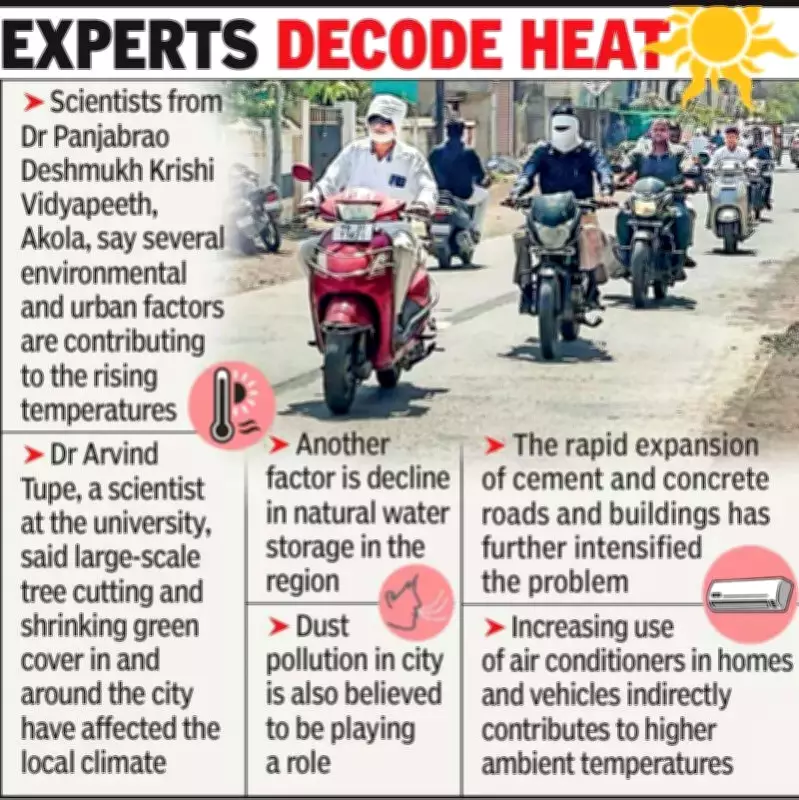
Scientists from Dr Panjabrao Deshmukh Krishi Vidyapeeth in Akola have identified multiple environmental and urban factors driving this temperature surge. Dr Arvind Tupe, a prominent scientist at the university, emphasized that extensive tree cutting and diminishing green cover in and around the city have profoundly impacted the local microclimate.
"Trees play a crucial role in natural temperature regulation. The reduction in green cover leads to increased heat absorption by surfaces and significantly diminished cooling effects," Dr Tupe explained during an interview.
Another critical factor is the decline of natural water storage systems in the region. Historically, ponds, wells, and small water bodies helped maintain soil moisture and moderate local temperatures through evaporative cooling. However, many of these traditional water sources have either disappeared or substantially shrunk over recent decades, directly contributing to rising heat levels.
Urbanization and Pollution Amplify Heating Effects
Dust pollution in Akola is also believed to be exacerbating the situation. Scientists note that when sunlight reaches the ground, it typically reflects back into the atmosphere. However, suspended dust particles interfere with this natural process, trapping heat closer to the surface and elevating ambient temperatures.
Rapid urbanization has further intensified the problem through what experts describe as a localized 'urban heat island' effect. The expansion of cement and concrete infrastructure—including roads and buildings—leads to greater heat absorption and retention. Deforestation in surrounding areas and inadequate plantation efforts have worsened these conditions.
Dr Tupe also highlighted an indirect contributor: "The increasing prevalence of air conditioners in homes and vehicles adds to ambient temperatures. The heat expelled by these cooling units accumulates in densely populated urban areas, creating a feedback loop that makes the environment even warmer."
Potential Mitigation Strategies and Community Impact
Experts propose several measures to combat rising temperatures:
- Enhancing water conservation through construction of ponds, small dams, and rainwater harvesting systems
- Storing rainwater for agricultural irrigation to maintain soil moisture
- Significantly increasing green cover through strategic plantation initiatives
Irrigated farmland has been shown to help keep surrounding areas relatively cooler, suggesting agricultural practices could play a role in temperature moderation.

The heatwave is already disrupting daily life in Akola. During afternoon hours, streets appear notably deserted as residents seek refuge indoors. Local shopkeepers express deep concern about what lies ahead. "If temperatures are already crossing 40 degrees in early March, we can only imagine how severe April and May will be," remarked one shopkeeper, capturing the prevailing anxiety in the community.
While Akola has traditionally been known as one of the hotter districts in Vidarbha, where summer typically intensifies by late February, the magnitude and timing of this year's temperature spike have drawn particular attention from climate experts and agricultural scientists. The situation serves as a stark reminder of how urban development, environmental changes, and climate patterns intersect to create challenging living conditions.





