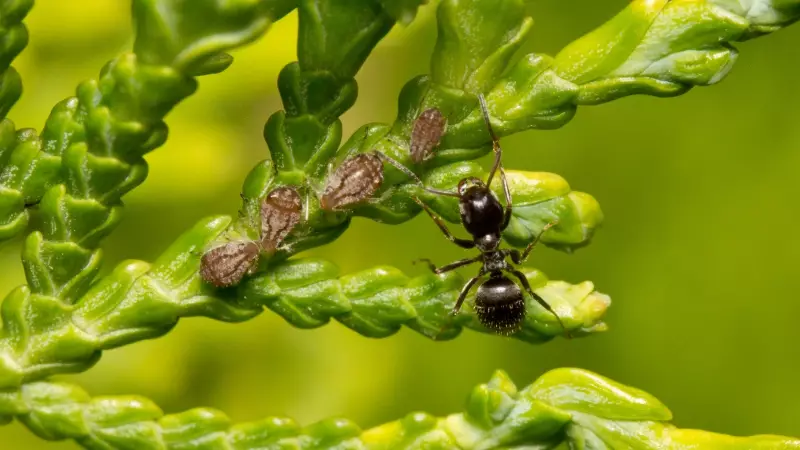
In a tale of treachery that rivals any political thriller, scientists have documented a shocking form of insect warfare. A parasitic ant queen invades a foreign colony and, through cunning chemical deception, convinces thousands of worker ants to murder their own mother and accept her as their new ruler.
From Hobbyist's Observation to Scientific Discovery
The dramatic saga began not in a high-tech lab, but through the keen eyes of an ant enthusiast. In 2021, hobbyist Taku Shimada placed a queen of the species Lasius orientalis—known for infiltrating other colonies—into a container with workers from a Lasius flavus colony. Overnight, the invading queen absorbed the workers' scent, crafting a perfect chemical disguise.
This mimicry is the key to her infiltration strategy in the wild. Armed with this new identity, Shimada introduced the impostor queen to the entrance of a real Lasius flavus nest. She behaved with the authority of a ruler, being fed by workers and brushing off any who challenged her. Her true mission, however, was far more sinister.

The Chemical Coup and Matricide
The coup unfolded hours later when the parasitic queen located the nest's resident mother queen. The invader initiated a brutal chemical attack, spraying the legitimate queen with a fluid, likely formic acid. This substance altered the mother queen's scent signature, throwing the colony into chaos.
Confused and agitated, the worker ants suddenly failed to recognise their own mother. Turning on her, they began a vicious attack. Over a gruesome four-day period, the parasitic queen sprayed the resident queen 15 times, continually reinforcing the deceptive chemical signal. Disturbed by this false alarm, the workers ultimately tore their mother queen apart.
A New Reign and Lasting Implications
With the true queen eliminated, the colony's loyalty shifted entirely. The workers accepted the parasitic invader as their new sovereign. Within ten days, she began laying her own eggs. Within a year, the entire colony—comprising roughly 3,000 ants—was populated solely by her offspring, completing the hostile takeover.
The discovery, later validated scientifically by ecologist Keizo Takasuka and published in the journal Current Biology, highlights a unique and brutal parasitic strategy. Researchers note the behaviour is especially remarkable because the killing workers gain no direct benefit; the advantage goes entirely to the invading queen.
This finding suggests such dramatic chemical matricide may be more common among related species than previously known. It underscores how much remains to be discovered about the complex, often violent social structures of ants, creatures that live in secret wars right beneath our feet. The research sheds new light on the evolutionary arms race and the sophisticated use of chemical warfare in the insect world.