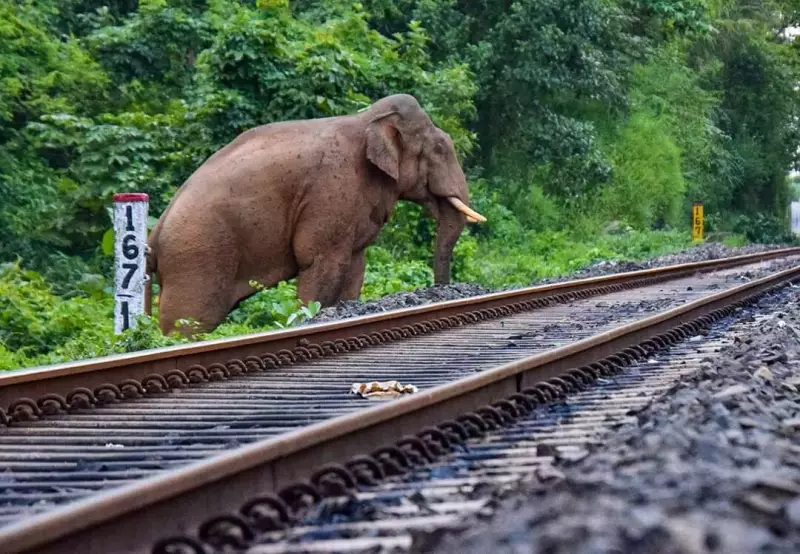
Railway authorities in Assam are facing a critical and evolving challenge: pinpointing the most sensitive stretches where wild elephants cross train tracks to build crucial wildlife crossings. This urgent task follows a tragic incident where eight wild elephants were killed by the Sairang-New Delhi Rajdhani Express at Sangjurai in Hojai district, amplifying demands for immediate, effective measures.
Stalled Plans and a Shifting Landscape
In 2024, the forest and railway ministries jointly proposed a series of interventions to prevent deadly train-elephant collisions. The recommended solutions included constructing level crossings, ramps, underpasses, and overpasses along vulnerable railway sections. However, these plans have not moved beyond the proposal stage and are still awaiting implementation.
NF Railway Chief Public Relations Officer KK Sharma confirmed to TOI that while funding and other aspects from the 2024 document are under government discussion, construction has not yet begun in Assam. The problem is compounded by the changing behavior of elephant herds. Over the past decade, herds have increasingly begun crossing tracks at new, unpredictable locations, rendering older maps obsolete.

A 2016 state government notification identified 33 elephant corridors along Assam's rail tracks. "The state govt, after discussions with railways and the forest department, should announce new vulnerable spots frequently used by elephants in recent years," said wildlife activist Pramod Kalita. He explained that elephant movement routes have changed significantly since 2016 due to encroachment from construction, human activities, and forest destruction in neighboring Meghalaya.
Technology as a Temporary Shield
While physical infrastructure projects lag, technology has emerged as a frontline defense. The railways have prioritized implementing Distributed Acoustic Sensing (DAS)-based Intrusion Detection Systems (IDS) on sensitive stretches. This artificial intelligence-based technology uses optical fibre networks to detect elephant movement near tracks by analyzing Rayleigh scattering in signals.
"This system provides real-time alerts to drivers and control rooms for timely action," Sharma stated. He credited the existing IDS network, which covers 62.7km of elephant corridors and 131km of block sections under NF Railway, with playing a significant role in saving over 160 elephants this year alone. However, officials admit that full compliance and coverage of all recommended stretches have not yet been achieved.
The Core Challenge: Identifying New Danger Zones
The most difficult recommendation from the 2024 proposal has been identifying railway stretches that pose collision risks to wildlife outside traditional elephant reserves and protected areas. Public reports consistently highlight new spots where elephant movement has begun, creating a moving target for planners.
This ongoing identification process is crucial for the effective placement of both high-tech systems and physical structures like underpasses. Until a dynamic, updated map of elephant movement is formalized and the proposed infrastructure projects receive the green light for funding and construction, the risk of more tragic collisions remains high.
The situation presents a complex puzzle for Assam: balancing vital rail connectivity with the urgent need to protect its iconic wildlife, whose ancient corridors now dangerously intersect with modern infrastructure.