

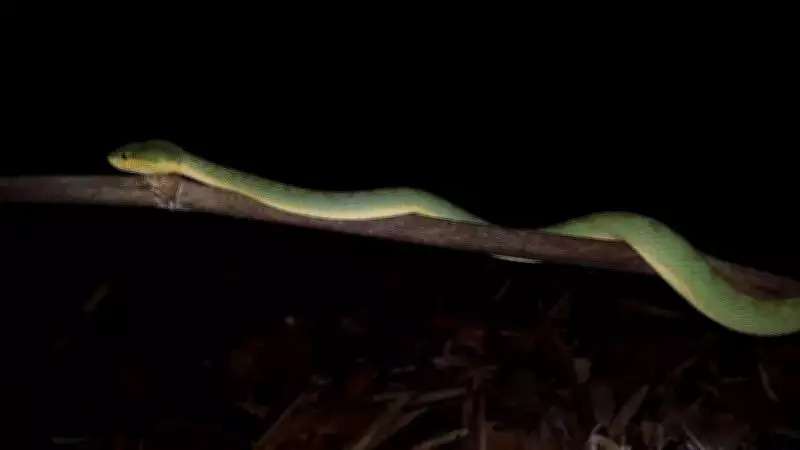
Surat-Germany Research Uncovers Bamboo Pit Vipers' Strong Site Fidelity in Dang Forests
A groundbreaking ecological study conducted by a researcher from Surat and a German scholar has revealed that bamboo pit vipers (Trimeresurus gramineus) in the Dang region of Gujarat exhibit remarkable fidelity to specific perches, demonstrating a profound dependence on particular trees and shrubs for their survival. This research underscores a critical ecological connection between the species and its vegetative habitat, with significant implications for conservation strategies.
Detailed Methodology and Key Findings
The study, carried out between January 2022 and May 2025, involved Dikansh Parmar from Surat and Dr. Hinrich Kaiser from the herpetology department at the Leibniz Institute for the Analysis of Biodiversity Change (LIB) at Museum Koenig in Bonn, Germany. Published in Discover Ecology, the research meticulously documented site fidelity in these pit vipers through extensive night surveys along forest roads.
During these surveys, researchers recorded 44 individual snakes, most of which were perched 3 to 7 meters above ground level on roots, shrubs, or bamboo growing from cliff-like slopes. To test site fidelity, the team collected the snakes, examined their scalation, determined their sex, measured their length, and photographed them before holding them in captivity for 48 hours. Subsequently, the snakes were released a few meters away from their original locations.

The results were striking: all translocated snakes returned to the exact perches from which they had been removed. "They kept going back," Parmar emphasized. "Even when we moved some snakes during observations, they returned to the identical perch within 72 hours. This behavior clearly indicates a tight linkage to specific microhabitats, which we haven't observed in previous snake studies."
Ecological Significance and Conservation Concerns
The bamboo pit viper is the only pit viper species recorded in Gujarat, representing the northernmost edge of its geographical range. Despite its International Union for Conservation of Nature (IUCN) status as 'least concern,' the species faces escalating threats from habitat disturbance, including road construction, erosion, vegetation clearing, and illegal wildlife trade.
Researchers explain that the snakes' slow-moving nature drives their preference for locations offering effective camouflage. Returning to the same spots provides a comparative survival advantage, as they blend seamlessly into bamboo thickets and foliage. The study also noted that snakes were not found during daytime, emerging from subterranean shelters just after dusk, with encounter frequency notably reduced during monsoon seasons.
Dr. Kaiser highlighted the broader implications: "This study reveals how closely certain species are tied to very specific microhabitats. Protecting these roots, shrubs, and bamboo is essential not only for the pit vipers but for the overall ecological balance of these forests. Even small roadside vegetation can be critical for survival."
Parmar added, "These snakes return to the same perches night after night, showing incredible loyalty to their home trees and shrubs. It's a vivid reminder that protecting wildlife sometimes begins with safeguarding a single root or tree."
Study Title and Author Background
The research, titled "Hanging in the Balance: An Ecological and Conservation Assessment Reveals Growing Threats to the Bamboo Pit Viper in the Dangs Forest of Gujarat, India," provides a comprehensive account of site fidelity and emphasizes the vital interdependence between the snakes and their vegetative environment.
The study's lead author, Dikansh Parmar, collaborated with Dr. Kaiser to offer insights that could inform future conservation efforts, stressing the need for habitat preservation in the face of developmental pressures.






