

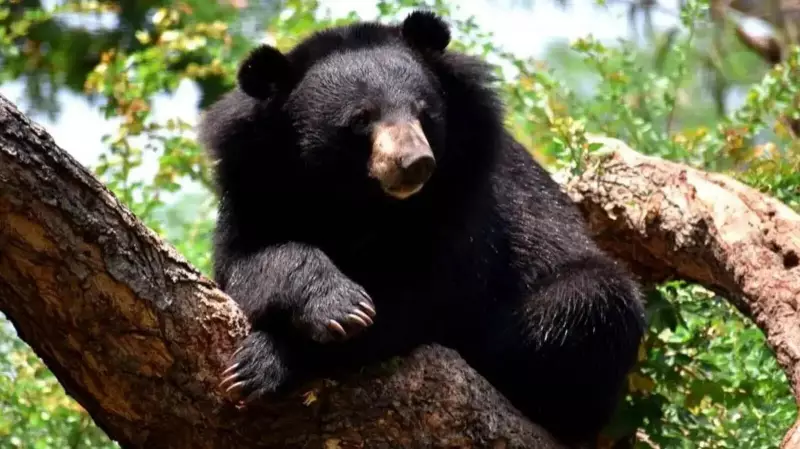
A Himalayan black bear has triggered panic in Srinagar after being spotted over four days at two of Kashmir's most prominent institutions: the University of Kashmir and the Sher-i-Kashmir Institute of Medical Sciences (SKIMS). The wildlife department has launched a major operation involving cages, drones, and CCTV review to locate and trap the animal.
Four-Day Saga of Bear Movements
The unusual incident began on Friday when the bear was first seen near the girls' hostel at the University of Kashmir (UoK) in Hazratbal. Campus CCTV footage captured a dramatic scene: the animal was being chased by street dogs outside the university gate. It then climbed an electricity pole and leaped into the campus near the hostel area. A university official revealed that two black bears had been seen in the Hazratbal locality that evening, and one entered the campus after the dog chase. Authorities believed it took refuge in the Botany Department's botanical garden, prompting an intensive search by wildlife teams.
By Sunday, the university declared the campus safe after wildlife officials conducted a thorough search and found no trace of the bear. However, the saga continued on Monday evening when the same black bear was sighted inside the premises of SKIMS, Srinagar's leading tertiary-care hospital. CCTV cameras again recorded the bear roaming within the institute. In response, wildlife officials placed a bear trap on the hospital grounds, but as of now, the animal remains at large.

Wildlife Department's Operation and Expert Analysis
A senior wildlife official explained that this Himalayan black bear was initially spotted in the Saidpora area. It then travelled through several residential localities before entering the University of Kashmir and later moving towards the SKIMS complex. An operation is actively underway to track the animal. The official urgently appealed to citizens to stop disposing of garbage in the open, as it attracts bears and other wild animals into human habitats.
Senior wildlife official Intisar Suhail provided crucial insight into this increasing trend. He stated that black bears are now hardly going into hibernation. "The effects of climate change, characterised by less precipitation, mainly snow; coupled with the availability of food in the form of garbage dumps, improperly disposed kitchen waste, and left-out fallen fruit in orchards, have enabled bears to skip hibernation and remain active through the winters," he explained.
Rising Human-Wildlife Conflict in Srinagar
This incident is not isolated. Sightings of bears and leopards around Srinagar have seen a noticeable increase in recent years, particularly during late autumn. Just last month, a bear was seen entering the prestigious Amar Singh Club, located near the high-security Gupkar Road, which houses the residences of the Chief Minister and several cabinet ministers. This pattern underscores a growing challenge of human-wildlife conflict in the region, driven by habitat overlap and changing environmental conditions.
The wildlife department's current strategy includes:
- Placing cages at key strategic locations.
- Deploying drones for aerial surveillance.
- Scrutinising hours of CCTV footage from both institutions.
- Conducting ground searches by trained teams.
The repeated appearances of the bear in highly populated and sensitive institutional zones have raised serious safety concerns among students, staff, hospital patients, and residents, highlighting the urgent need for effective waste management and wildlife mitigation strategies.






