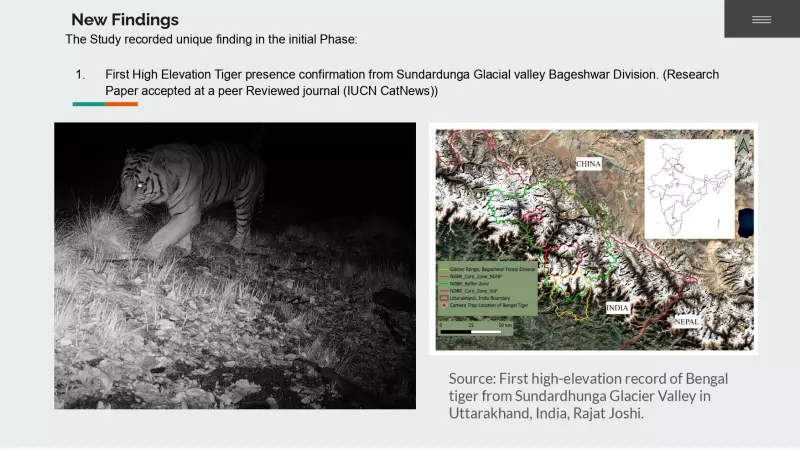
In an unexpected ecological revelation, a Bengal tiger has been photographed at a staggering altitude of 3,010 metres in Uttarakhand's Himalayas. The discovery was made not by direct human observation, but through a camera trap installed as part of a project originally designed to study the elusive snow leopard.
A Surprising Discovery in the Snow Leopard's Domain
The image, with a clear timestamp of May 16, 2025, was captured in the remote Sunderdhunga glacier valley in Bageshwar district. This sighting now stands as one of the highest verified records of the Bengal tiger in this region. The project, titled "Securing Snow Leopard Habitat and Alpine Ecosystems in the Kumaon Himalayas," is run by the Uttarakhand Forest Department with support from the Union Ministry of Environment's National Mission for Green India.
Researchers retrieved and processed the image after the first phase of the project concluded in July 2025. Aditya Ratna, the Divisional Forest Officer (DFO) of Bageshwar, pointed out a critical detail: the camera trap image showed the tiger with a sambar deer. This directly links the predator's presence to a robust prey population in these high, rugged mountains.

Implications for Conservation and Big Cat Movement
The finding raises significant questions about the movement patterns of tigers from the lowland Terai forests into the high hill districts. Officials are analyzing whether this was a one-time exploratory journey or part of a seasonal migration. Fresh tiger scat and local reports of large cats further supported the camera trap evidence. This is estimated to be only the second tiger sighting within the Bageshwar forest division.
The research also recorded other species, revealing a thriving ecosystem:
- Himalayan serow
- Goral
- Barking deer
- Sambar deer (found as high as 4,000 metres)
According to Rajat Joshi, a junior research fellow on the project, the work focuses on conserving high-altitude biodiversity across fragile alpine zones vital for species like the snow leopard and Himalayan musk deer. A summary of the findings, slated for publication in IUCN Cat News, states that this discovery reinforces the urgent need to protect Himalayan habitats and maintain ecological corridors connecting lowland forests to high mountains.
Connecting the Dots: From Corbett to the Glaciers
The lowland Terai forests, including the famed Corbett Tiger Reserve in neighbouring Nainital district, boast a high tiger density. Corbett alone recorded 260 tigers in recent estimations, with populations in adjoining areas growing multi-fold since the 2022 national tiger census. While tigers have occasionally been recorded in high-altitude areas of Almora, Bageshwar is further removed from the plains, making this sighting particularly notable.
The second phase of the monitoring project is now underway, which officials hope will provide clearer answers on the nature of this big cat's movement. The terrain itself presented challenges; the area is so remote that retrieving the camera trap data required long treks through steep paths. Fieldwork involves complex logistics, from hiring porters and mules for equipment to ensuring safety in isolated regions.
This remarkable discovery in the 'valley of beautiful stones' (Sunderdhunga) underscores a dynamic and interconnected wilderness. It highlights that conservation efforts for one flagship species, like the snow leopard, can yield surprising insights about others, ultimately stressing the importance of holistic ecosystem protection for the long-term survival of India's majestic wildlife in a changing climate.