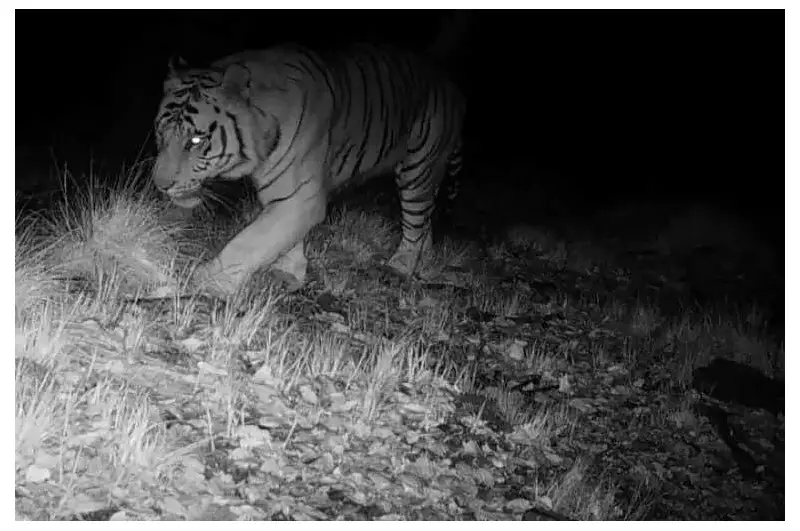
In an extraordinary wildlife discovery, a Bengal tiger has been photographed at an altitude exceeding 9,875 feet in the Sunderdhunga Glacier Valley of Uttarakhand's Bageshwar district. This marks the highest confirmed tiger sighting ever recorded in the hill district, according to forest officials.
Unprecedented High-Altitude Discovery
The remarkable image was captured by a camera trap installed as part of a joint study conducted by the Union Ministry of Environment, Forest and Climate Change and the Uttarakhand Forest Department. The study primarily focuses on snow leopard conservation and the fragile alpine ecosystems of the region.
Aditya Ratna, the Divisional Forest Officer (DFO) of the area, stated that the finding reveals an unusual overlap in the territories of major carnivores like tigers and snow leopards. "It raises critical questions about wildlife movement, habitat shifts and the connectivity of our mountain landscapes," he explained. Typically, tigers are found below 6,000 feet, making this sighting particularly significant.

Historical Context and Scientific Significance
While rare, this is not the first instance of tigers venturing into high Himalayan zones. Similar high-elevation sightings in Uttarakhand include:
- A tigress at around 10,700 feet in the Askot Musk Deer Wildlife Sanctuary in March 2016.
- Another tiger at an astounding 11,155 feet in the Kedarnath Wildlife Sanctuary in 2019.
The latest camera-trap image shows an adult tiger moving through a dense sub-alpine forest near the treeline. Its presence was further corroborated by fresh scat and local reports. Researchers interpret these sightings as evidence that tigers occasionally use high-altitude corridors, likely during dispersal phases when young animals seek new territories.
This behaviour is seen as a potential indicator of how Himalayan wildlife is adjusting its movement patterns in response to climate change and increasing human pressure. The discovery's importance is underscored by its acceptance for scientific publication, highlighting its global relevance.
Conservation Efforts and Logistical Challenges
The ongoing monitoring project is supported under the National Mission for Green India (GIM). It aims to conserve high-altitude biodiversity in the fragile alpine and subalpine zones of the Kumaon Himalayas, which are critical habitats for the snow leopard, Himalayan musk deer, and other species.
Forest researcher Rajat Joshi and his team have deployed 55 strategically placed trap cameras across the Pindari, Sunderdhunga, and Kafni regions. The project also captured images of other species like the Himalayan serow, goral, barking deer, and sambar deer at these heights, indicating a healthy prey base even in harsh mountain habitats.
Joshi emphasized that the project employs long-term ecological monitoring, community engagement, camera traps, and GIS-based habitat mapping to improve conservation, reduce human-wildlife conflict, and support sustainable mountain livelihoods.
However, ecological research in these landscapes presents major challenges. "Many sites lie close to 10,000 feet and are accessible only by long treks through steep terrain. Harsh weather, limited infrastructure and high costs add to the burden," Joshi noted. Despite these constraints, he stressed that systematic monitoring remains essential for understanding these unique ecosystems and guiding future conservation planning.
The discovery prompts a crucial question for scientists: could the high Himalayan landscapes eventually support resident tiger populations? Continued monitoring will be key to assessing this possibility and understanding the full implications of such remarkable wildlife movement.