

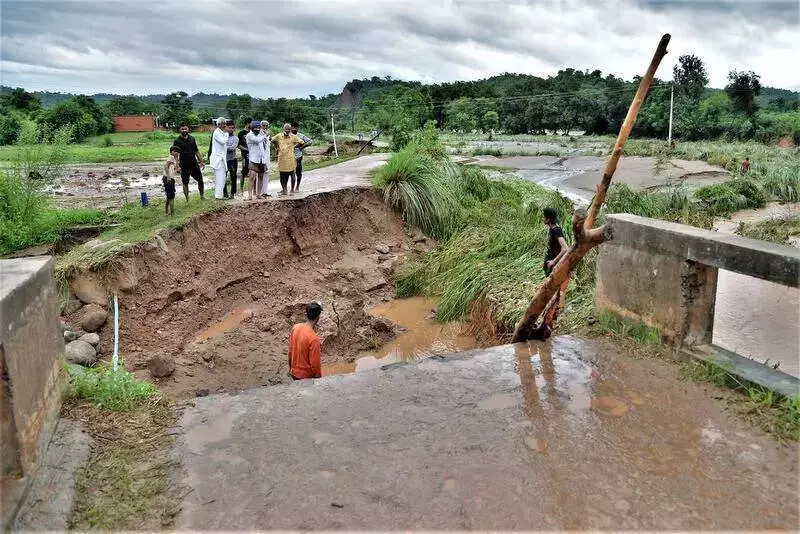
The central government has categorically denied allegations that poor reservoir management at the Bhakra and Pong dams exacerbated the devastating floods in Punjab earlier this year. This rebuttal comes in response to the Punjab government's claims and follows a petition filed by activists in the National Green Tribunal (NGT).
The Scale of Devastation and Conflicting Blame
The monsoon floods of 2025 left a trail of destruction across Punjab. Official figures reveal the crisis ravaged nearly 2,300 villages, affecting the lives of over 4 lakh people. The human cost was severe, with 55 deaths reported across 14 districts. The agricultural heartland suffered immensely, with 1.7 lakh hectares of farmland damaged across 18 districts. The disaster also destroyed thousands of homes, livestock, and critical public infrastructure.
In the aftermath, environmentalists approached the NGT, alleging systemic negligence by the Bhakra Beas Management Board (BBMB) and the state government. The BBMB, however, countered by holding the Punjab government responsible, accusing it of failing to conduct timely desilting of rivers and canals and neglecting the strengthening of embankments.

Centre's Defence: Record Inflows and Coordinated Releases
Responding to a query in the Rajya Sabha by MP Sanjay Raut, the Union Ministry of Jal Shakti provided a detailed clarification. The ministry stated, "Recent floods in Punjab were not aggravated due to poor reservoir management at major dams (of) Pong and Bhakra."
The ministry attributed the crisis to extensive rains in the catchments of the two dams in 2025, which led to unprecedented inflows. The Pong dam received a massive 3.5 lakh cusecs, while Bhakra dam saw inflows of 1.9 lakh cusecs. It asserted that reservoir regulation was done with the objective of achieving "maximum moderation and absorption of floods."
Water releases were made based on decisions by a technical committee that included representatives from partner states—Punjab, Haryana, and Rajasthan—along with the Central Water Commission (CWC) and the BBMB. These decisions considered the rule curve, dam-safety parameters, and the limited carrying capacity of the Satluj and Beas rivers downstream. The ministry emphasized that releases were made only after a minimum advance notice of 24 hours to downstream areas.
Future Measures and Ongoing Responsibilities
On the question of maintaining buffer levels before the monsoon, the Centre clarified that pre-monsoon reservoir levels and storage were within average ranges and the necessary buffer capacity was maintained.
Looking ahead, the ministry outlined several measures to prevent future disasters:
- Structural works like embankment strengthening and drainage improvement remain the responsibility of state governments.
- Under the Dam Safety Act, 2021, the National Dam Safety Authority (NDSA) has directed dam owners to establish early warning systems and ensure real-time, three-hourly data sharing.
- The NDSA has also mandated better coordination for cascading reservoirs and strict adherence to the approved rule curve during high floods.
- The Union ministry has circulated technical guidelines on floodplain zoning to all states and UTs as a non-structural management approach.
The ministry also rejected the need for a new joint control mechanism, stating the existing technical committee already serves that purpose. This stance contrasts with Punjab's Water Resources Minister Barinder Kumar Goyal's earlier claim that timely water release by the BBMB in June could have significantly reduced the flood damage.






