

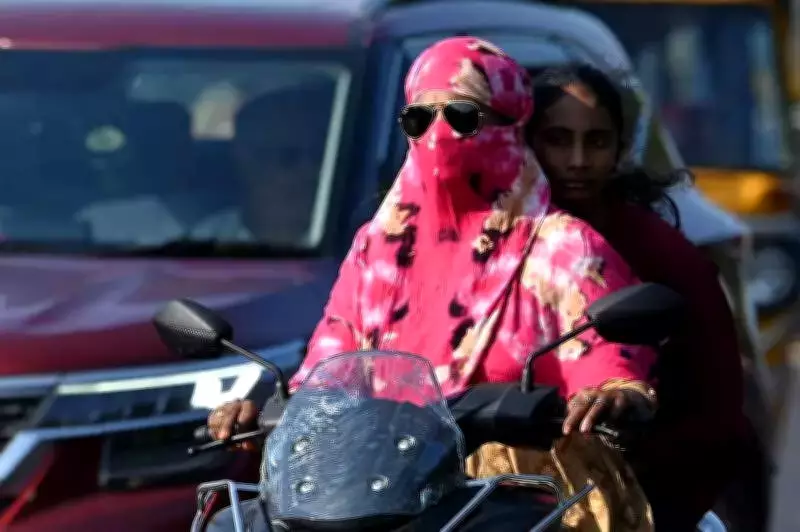
Chennai Residents Report Extreme Heat as Primary Climate Impact Amid IMD Warning
As the India Meteorological Department (IMD) issues a heatwave warning for Chennai, a comprehensive new survey reveals that extreme heat has already become the most widely experienced climate impact among the city's residents. The findings come from the Climate Change Perception Study: Chennai 2026, conducted by Climate Trends, which interviewed 2,000 residents across various neighborhoods.
Heat Stress Dominates Daily Life
The survey data shows that heat stress has emerged as the dominant climate hazard affecting daily life in Chennai. According to the report, "Extreme heat emerges as the most experienced hazard, with 1,594 respondents reporting personal impact." This represents a significant majority of those surveyed and indicates that climate impacts are "no longer abstract future threats" but present realities.
This finding aligns with IMD's forecast for March to May, which warns that Chennai could experience up to six days of heatwave conditions, while adjoining coastal districts may face as many as 15 days of extreme heat. The convergence of survey data and meteorological predictions paints a concerning picture of escalating thermal stress in the region.

Climate Change Through Lived Experience
The report found that Chennai residents primarily associate climate change with pollution and changing weather patterns rather than global climate science narratives. This suggests people interpret the phenomenon through direct, lived experiences such as worsening air quality, erratic rainfall patterns, and steadily rising temperatures over recent years.
"People aren't just aware of climate change; they are living it every day," emphasized Aarti Khosla, founder and director of Climate Trends. "With 85% of residents seeing this as a personal risk, there is a mandate for the government to deliver effective solutions."
Multiple Climate Hazards Across City Zones
Beyond heatwaves, the survey documented several other climate-related challenges:
- 70% of respondents reported experiencing water shortages
- More than half of those surveyed had experienced flooding events
- Different parts of Chennai face distinct climate stresses based on geography and infrastructure
The report detailed how these impacts vary across the city:
- North Chennai experiences severe heat and water stress, exacerbated by industrial activity and weak infrastructure
- Central Chennai faces heat, water shortages, and periodic power cuts
- Coastal East Chennai frequently experiences flooding and power outages
- Rapidly expanding South Chennai reports increasing water stress as development outpaces infrastructure
Compounding Vulnerabilities and Public Response
The convergence of heat stress and water scarcity creates particularly severe vulnerabilities for outdoor workers and households without reliable piped water supply. These compounding effects amplify risks for already marginalized communities.
Despite these challenges, the survey revealed strong public support for climate action measures:
- Approximately 75% of respondents favor restrictions on polluting vehicles
- 70% support subsidies for electric vehicles, even if funds must be reallocated from other sectors
Communication Gap and Government Response
The survey highlighted a significant communication gap, with 56% of respondents reporting they had not encountered any climate awareness campaign in the past six months. This is particularly noteworthy since scientists and government agencies remain the most trusted sources of climate information among residents.
State forest secretary Supriya Sahu commented on government efforts, stating: "Five years ago, climate change was integrated into our department, and since then we moved from policy to measurable action. Action is accelerating across mitigation, adaptation, ecosystem restoration, and building biodiversity."

The comprehensive survey provides crucial data as Chennai prepares for predicted heatwave conditions, offering insights into how residents experience climate impacts and what solutions they support to address these growing challenges.





