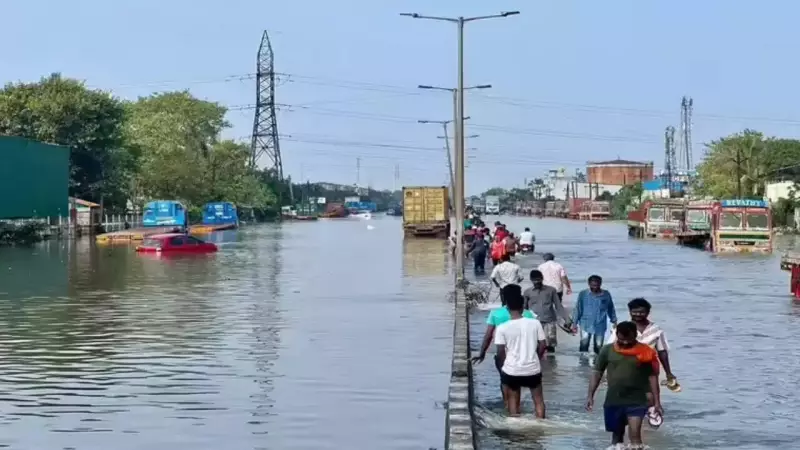
The heavy downpours that lashed Northern Tamil Nadu last month served as a stark reminder of Chennai's fragile relationship with water. Streets transformed into rivers, homes were inundated, and daily life ground to a halt as the remnants of Cyclonic Storm Ditwah battered the region. For residents wading through knee-deep water, the traumatic memories of past floods came rushing back.
Massive Investment, Persistent Problems
The Greater Chennai Corporation (GCC) has undertaken a colossal effort to fortify the city against such deluges. Between 2021 and 2025, the civic body laid an impressive 1,144.5 km of stormwater drains, investing approximately Rs 5,000 crore. A flagship project in the Kosasthalaiyar basin, backed by the Asian Development Bank, accounted for 641 km of this network at a cost of around Rs 3,059 crore.
Yet, the recent flooding revealed critical limitations. Authorities confirmed four rain-related deaths, with thousands of homes and acres of crops destroyed. The core issue, experts point out, is that laying drains is not enough. Major canals and rivers remain choked, and thousands of encroachments obstruct the natural flow of water.

Encroachments Choke Critical Waterways
The problem is systemic. Vital channels like the Buckingham Canal face significant encroachments in areas like Mylapore and Chepauk. This canal is a crucial artery connecting the sea to the Kosasthalaiyar, Cooum, and Adyar rivers. Each of these rivers, in turn, suffers from over 1,000 illegal structures.
In North Chennai, neighborhoods received nearly double the rainfall of other areas. Here, encroachments along the Kosasthalaiyar River left communities exceptionally vulnerable. At its confluence with the Puzhal channel and Buckingham Canal in Ennore, absent boundary walls allowed water to breach and swamp local settlements, forcing many to evacuate.
Wetlands Under Threat: Pallikaranai and Ennore Creek
In a significant move, the National Green Tribunal (NGT) recently halted all construction approvals in and around the Pallikaranai Marsh, Chennai's last surviving major wetland. A mapping exercise found that over 40% of the 21.25 sq km marshland is encroached. The NGT emphasized its role in flood prevention, as 50 stormwater inlets discharge directly into it.
The story is similar in North Chennai. The Save Ennore Creek campaign documented 667 acres of backwaters encroached by public sector units after the 2015 floods. Other estimates suggest over 1,000 acres of the 8,000-acre creek system are occupied, with fly ash from power plants reducing channel depth.
Climate Change and Uncoordinated Planning Amplify Risk
A recent scientific study paints a grim future, warning that flood risk along Tamil Nadu's coast will intensify due to unchecked urban growth and climate-induced erratic rainfall. Districts like Chennai, Cuddalore, and Chengalpet are identified as both low-lying and high-risk zones.
Professor Balaji Narasimhan of IIT-Madras highlights a fundamental governance flaw. "Chennai's water supply and sewerage are managed by the CMWSSB, while the GCC oversees stormwater drainage. This division creates gaps and conflicts," he explains. He advocates consolidating these functions under one agency for integrated planning.
Narasimhan also stresses the need for a comprehensive drainage master plan and flood hazard assessment. He recommends moving beyond grey infrastructure like drains to incorporate blue-green infrastructure, which would help recharge aquifers and build resilience against both floods and droughts.
Learning from the 2015 Catastrophe
The shadow of the devastating 2015 flood, which claimed hundreds of lives, looms large. Research indicates that flood losses could have been 17% lower and fatalities 12% less if the city's traditional rainwater-storing tanks had been intact. Areas like T Nagar and Ashok Nagar could have seen water levels reduced by up to 0.8 meters.
Activist A Narayanan questions the official toll from that disaster, stating, "The official figure of 347 deaths in 2015 cannot be accepted. Ambulances simply could not move during the floods." The event remains a political flashpoint, with debates in the assembly over responsibility.

While projects like a Rs 42 crore stormwater diversion in Perumbakkam offer localized hope, the overarching challenge remains. Chennai has witnessed five major floods between 1943 and 2005. Experts unanimously argue that only integrated planning, combining grey and blue-green infrastructure, rigorous protection of water bodies, and climate-sensitive urban development can reduce the city's profound vulnerability. Without these structural and policy reforms, Chennai's battle with water is far from over.