

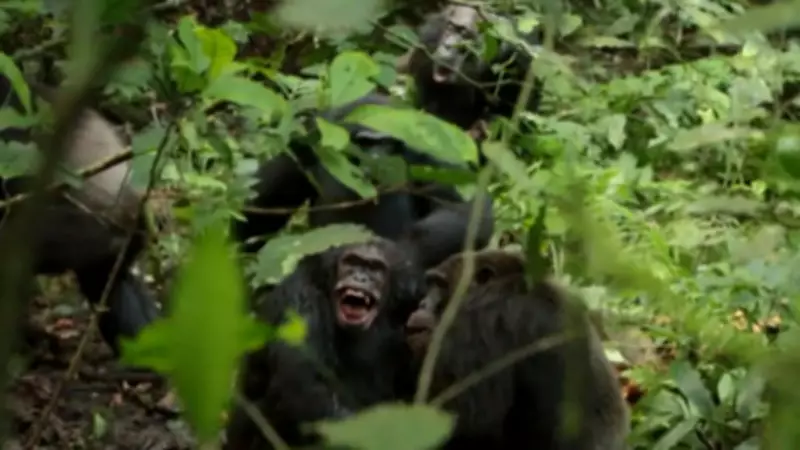
From Unity to Division: The Ngogo Chimpanzee Civil War
Once a model of primate harmony, the Ngogo chimpanzees of Uganda's Kibale National Park have descended into an eight-year civil war that has shocked researchers. This community, recognized as the world's largest known group of wild chimpanzees, has transformed from a close-knit society into two hostile factions engaged in lethal conflict. A groundbreaking study published in the journal Science reveals this rare and violent schism, documenting how former allies now kill each other in a struggle that mirrors human warfare.
The Fracture of a Primate Society
For decades, the nearly 200 Ngogo chimpanzees lived in remarkable unity. They groomed each other meticulously, shared food resources generously, and moved through their forest territory as a cohesive unit. This peaceful coexistence made their sudden division all the more startling to scientists. The group has now split into two distinct sects identified by researchers as the Western and Central factions. What began as social tension has escalated into a deadly conflict with at least 24 documented attacks since the separation.
Lead author Aaron Sandel, an anthropologist from the University of Texas and co-director of the Ngogo Chimpanzee Project, describes chimpanzees as "very territorial" creatures prone to "hostile interactions with those from other groups." Yet the Ngogo community had long defied this tendency, maintaining internal harmony until recent years. The current conflict represents an extraordinary breakdown of social bonds in a species where community splits are estimated to occur only once every 500 years on average.

The Escalation of Violence
The war's origins trace back to 2015 when researchers first observed polarization within the group. Sandel recalls witnessing the Western faction fleeing as Central members gave chase during an early confrontation. He describes the chimpanzees as "melodramatic," capable of shifting rapidly from "screaming and chasing" to grooming and cooperation. Following this initial dispute, a six-week avoidance period ensued where interactions between the factions dwindled significantly.
When contact resumed, encounters grew more intense and aggressive. By 2018, two clearly defined groups had emerged, with the smaller but more aggressive Western faction initiating attacks against their former Central companions. The violence has proven devastatingly effective: through 24 documented attacks, Western chimpanzees have killed at least 7 adult males and 17 infants, though researchers suspect the actual death toll is higher.
Basie's Tragic Death: A Turning Point
The killing of 36-year-old chimpanzee Basie stands as a particularly poignant moment in the conflict. Sandel described to National Geographic how Basie began his final day peacefully—waking in his nest among dozing companions, swinging through branches, and snacking on ripe figs. As sunset approached, his tranquility shattered when a patrol of approximately 13 adult chimps from the Western faction arrived. Three adults surrounded Basie while ten others attacked him on the ground, piling on and biting viciously.
"In the moment, I felt like a war correspondent," Sandel reflected. "I wanted to be there, I wanted to witness it, to document it, and try to understand what's going on. Once I'd written up my notes and shared them with colleagues, that's when the emotions hit me." Basie's death marked only the second casualty in the new war, but it forced researchers to confront how a once tightly-bonded community could descend into such brutal internecine violence.
Causes of the Social Collapse
Scientists have identified several factors contributing to the chimpanzees' dramatic turnaround:
- Group size and resource competition: As the community grew, competition for food and territory intensified
- Male-male reproductive competition: Rivalry among males for mating opportunities created underlying tensions
- Loss of key social connectors: The deaths of influential individuals weakened the bonds holding subgroups together
Researchers pinpoint three specific events as critical catalysts for the conflict:

- The 2014 deaths of five adult males and one adult female, which disrupted social networks
- The 2015 deposition of the established alpha male by a new leader named Jackson, coinciding with the first separation period
- A 2017 respiratory epidemic that killed 25 chimpanzees, including adult males who served as "among the last individuals to connect the groups"
Co-author Jacob Negrey, a primatologist at the University of Arizona, explains: "When you stop coming together, it's possible to stop seeing yourselves as part of the same group. That can lead to violent consequences in a shockingly short period of time."
Historical Parallels and Human Implications
This is not the first documented chimpanzee civil war. In the mid-1970s, renowned primatologist Jane Goodall witnessed a four-year conflict at Tanzania's Gombe Stream National Park. In her memoir Through a Window, she described those years as the "darkest" in Gombe's history, confessing she "struggled to come to terms with … a dark side to their nature."
Both Goodall's observations and Sandel's research reveal common precursors to chimpanzee warfare: changes in leadership structures, deaths of key social connectors, and disease outbreaks that disrupt community cohesion. These findings carry profound implications for understanding human conflict.
"The war is ongoing—it's not finished yet," Negrey emphasizes. As humanity's closest living relatives, chimpanzees engage in warfare without the ideological divisions—religion, politics, ethnicity—that typically characterize human conflicts. This suggests that relational dynamics may play a larger causal role in human conflict than often assumed. The Ngogo chimpanzee war challenges us to reconsider how social bonds, when broken, can lead to violence even in the absence of ideological differences.
The ongoing conflict continues to unfold in Uganda's forests, offering scientists a rare window into the social mechanics of primate warfare and what it might reveal about our own species' propensity for organized violence.





