

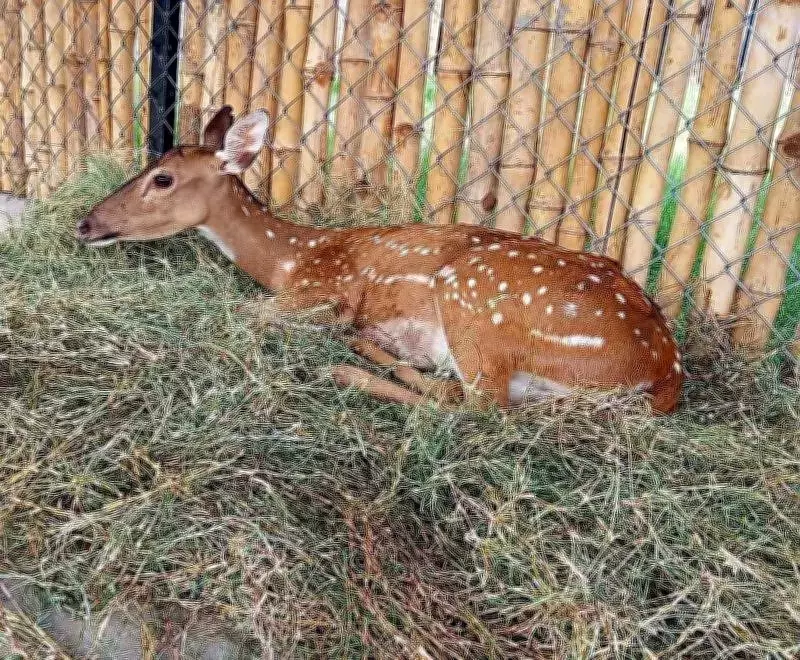
Coimbatore Wildlife Centre Successfully Treats Two Injured Spotted Deer
Forest officials in Coimbatore district have reported that two female spotted deer recently admitted to the Wildlife Transit and Treatment Centre (WTTC) at Pethikuttai in the Sirumugai forest range are showing significant improvement after receiving necessary medical care. The animals were rescued from separate incidents in the Mettupalayam forest range and are now recuperating in the quarantine facility for herbivores.
Rescue and Treatment of the First Deer
The first case involved a two-and-a-half-year-old female spotted deer discovered with a PVC pipe stuck on its left hind leg, causing difficulty in walking. Forest staff successfully rescued the distressed animal on March 16 and transported it to the WTTC for urgent treatment. A minor surgical procedure was performed at the operation centre a couple of days later to remove the obstruction and address the injury.
Second Deer with Fractured Leg
On March 20, another female spotted deer was found with a fracture in its front left leg. Officials believe the injury likely occurred when the deer attempted to escape from stray dogs in the Mettupalayam area. The injured animal was promptly rescued and taken to the WTTC, where it received appropriate medical attention. Both deer have responded well to treatment and are currently under observation during their recovery phase.

Expanding Wildlife Rehabilitation Efforts
Since its inauguration in December last year, the Wildlife Transit and Treatment Centre has expanded its rehabilitation services beyond deer. The facility has also treated a pair of slender lorises and a kite, which were initially cared for at the Avian Recuperation Centre at the district forest office in north Coimbatore before being transferred to the WTTC for specialized care.
"We administered energy tonics and closely monitored the health of both slender lorises before releasing them in the Udumalai forest range once their condition improved satisfactorily," explained an official from the centre. "Similarly, after the kite regained its flying capability, we released it at the Bhavanisagar backwaters."
The successful treatment of these animals highlights the growing importance of dedicated wildlife rehabilitation centres in Tamil Nadu's forest regions. The WTTC's multidisciplinary approach to animal care demonstrates how specialized facilities can contribute to conservation efforts by providing timely medical intervention for injured wildlife, ultimately supporting biodiversity preservation in the region.






