

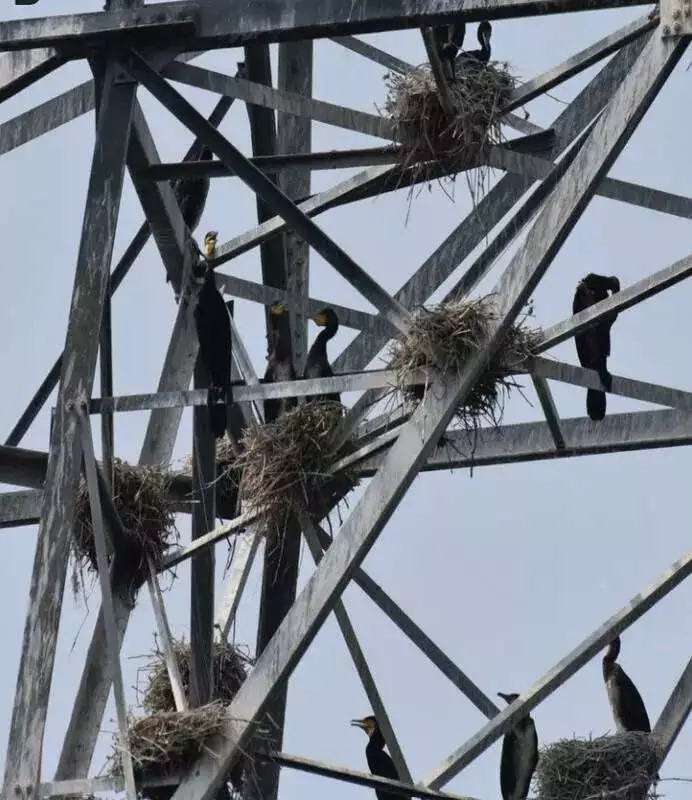
In a striking example of avian adaptation, great cormorants have turned high-voltage electricity transmission pylons into an unconventional breeding ground on the outskirts of Chennai. This unusual behaviour, documented by researchers, underscores the birds' response to the loss of their natural habitats.
Pylons Turned into Avian Apartments
A detailed study conducted by the Wildlife Institute of India (WII) in Dehradun has recorded this fascinating phenomenon. The research, published in the Zoo's Print journal, focused on a wetland area flanked by paddy fields along State Highway 58, which connects Kancheepuram and Arakkonam.
Scientists documented a total of 59 nests of the great cormorant (Phalacrocorax carbo) built on two separate 400kV transmission towers. On the first pylon, researchers counted 24 nests, of which 22 were found to be abandoned. The second pylon supported 13 nests, with a mere three being active at the time of the study.

G V Gopi, the corresponding author of the study, stated that during their observation, they counted 89 great cormorants in the surrounding wetland, a mix of both adult and juvenile birds. He also noted that similar behaviour, where cormorants and pelicans use transmission lines for roosting, has been observed at the Pallikaranai marshland as well.
A Shift from Trees to Towers
In Tamil Nadu, great cormorants have traditionally preferred specific tree species for nesting. Their typical choices include the babul (Vachellia nilotica), the southern blue gum (Eucalyptus globulus), and the toddy palm (Borassus flabellifer).
S J D Frank, the first author of the study, highlighted a significant trend. He explained that the use of human-made structures by birds for nesting purposes has seen a noticeable increase in recent years. "Birds now frequently nest on a variety of artificial structures," Frank said. He emphasized the potential conservation benefit, adding, "The availability of these artificial structures in regions with limited nesting opportunities can ultimately support species conservation."
Local sources indicate that this specific colony on the pylons began its unusual tenure in 2021. Initially, the birds used only one transmission tower for both nesting and roosting. However, from 2022 onwards, they expanded their territory to occupy both pylons, as confirmed by researcher Gopi.
Implications for Future Conservation
The wetland ecosystem supporting these pylon-nesting cormorants is biodiverse. It is also home to other significant waterbird species, including the spot-billed pelican, eastern cattle-egret, Indian pond-heron, and the oriental darter.
While tree-based breeding remains the norm for waterbirds across India, this research opens a new chapter in conservation strategy. Artificial structures like transmission towers, buildings, or other installations could provide crucial alternative nesting sites in degraded or crowded habitats.
Frank stressed the importance of ongoing observation, stating, "Monitoring the breeding behaviour of great cormorants and other colonial nesting waterbirds is crucial for understanding the role of artificial structures in their nesting ecology." This adaptive behaviour of the great cormorants near Chennai serves as a live case study in how wildlife persists and evolves in human-altered landscapes.






