

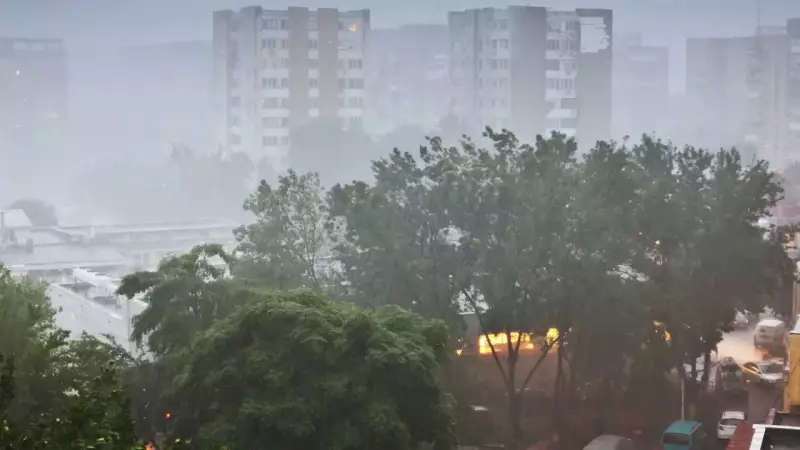
The India Meteorological Department has reported significant developments regarding Cyclonic Storm Ditwah in its latest All-India Weather Bulletin. The storm, which previously threatened to intensify over the southwest Bay of Bengal, has now weakened into a deep depression as of Sunday night.
Current Position and Movement
The weakened system was centered approximately 90 km east of Cuddalore and 140 km south-southeast of Chennai as of 1730 IST on November 30. The depression continues to move northward, almost parallel to the coastline, and is expected to come within 20 km of land by Monday morning. However, forecasters confirm that no landfall is expected.
Meteorologists predict that by December 1 morning, Ditwah will weaken further into a depression and continue decaying as it tracks north-northeastward. Despite losing strength, the system continues to unleash heavy rain, strong winds, and turbulent sea conditions along the Tamil Nadu-Puducherry and south Andhra Pradesh coasts.

Rainfall Warnings and Impact
The IMD has issued comprehensive rainfall warnings as Ditwah continues to feed moisture onto the coast. Heavy rainfall will gradually shift toward coastal Andhra Pradesh, Yanam, and Rayalaseema, with the risk of localized flooding persisting for the next 48 hours.
On December 1, the system's moisture is expected to reach inland areas, bringing heavy rainfall over Telangana. Officials emphasize that despite the system's weakening, widespread wet conditions will continue at least until Monday, particularly along the Tamil Nadu-south Andhra belt.
Thunderstorm and Lightning Alert
Frequent lightning and thunderstorm activity are forecast across multiple regions: Tamil Nadu, coastal Andhra Pradesh, Yanam, and Rayalaseema until December 3; south interior Karnataka on December 1; Kerala and Mahe on December 2 and 3; and north interior Karnataka on December 1.
Residents in these regions are strongly advised to avoid open fields, metal structures, and waterlogged areas during storm episodes for their safety.
Marine Conditions and Fishermen Advisory
Wind speeds are expected to decrease progressively by Monday morning, but sea conditions in the southwest Bay of Bengal remain high to very rough, posing serious danger to ports and marine operations.
A complete suspension of fishing remains in force along Sri Lanka, Tamil Nadu, Puducherry, and south Andhra Pradesh coasts till December 1, and along the Andhra Pradesh coast till December 2. Fishermen have been strictly advised not to venture into Southwest Bay of Bengal, Gulf of Mannar, Comorin area, and Tamil Nadu-Puducherry-Sri Lanka coasts.
District administrations in Cuddalore, Nagapattinam, Chennai, and Nellore have deployed coastal police teams to prevent fishermen from attempting hazardous trips during this period.
Flash Flood Risk and Extended Outlook
A low to moderate flash-flood risk exists over areas near Guntur, Krishna, Prakasam, Nellore in Coastal Andhra Pradesh, and Chittoor and Kadapa in Rayalaseema. The IMD urges residents in these areas to monitor local advisories closely, especially near streams and low-lying regions.
According to IMD's extended outlook, rainfall activity will begin to reduce from December 2 onwards, with Kerala likely to receive scattered to fairly widespread showers until December 6. Much of the rest of India will remain dry or see only isolated showers during the week.
Contrasting Weather Patterns Across India
While southern India battles excessive rainfall, northwest India is experiencing an early-winter chill. Minimum temperatures have dropped below 6 degrees Celsius in many parts of Ladakh and Himachal Pradesh, and between 6 degrees Celsius and 10 degrees Celsius in Punjab, Haryana, Delhi, and western Uttar Pradesh.
Cold wave conditions are likely in isolated pockets of Punjab till December 2, with dense fog expected during early morning hours in parts of Himachal Pradesh and Odisha.

Authorities continue to urge the public to remain cautious, avoid unnecessary travel, and follow official advisories as Cyclone Ditwah gradually winds down. Conditions are expected to ease from December 1 afternoon onward, though the system's proximity to the coast ensures that heavy rain, strong winds, and rough seas will persist along Tamil Nadu and south Andhra Pradesh until then.





