

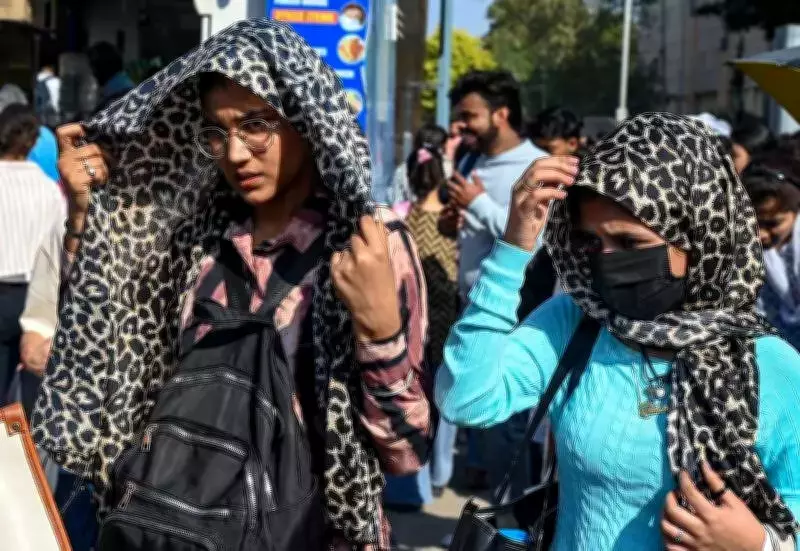
Delhi Gripped by Unseasonal Early Summer Heatwave
Residents of the national capital are experiencing unusually warm conditions for this time of year, with both daytime and nighttime temperatures soaring significantly above seasonal averages. The city recorded its warmest morning of the season on Monday, as the minimum temperature climbed to 19 degrees Celsius, marking a substantial five-degree increase above the normal range.
Temperature Trends and Meteorological Insights
The maximum temperature has remained stubbornly above the 35 degrees Celsius threshold for three consecutive days, creating early summer-like discomfort. On Monday, despite some overcast skies in parts of the city, the mercury reached 35.3 degrees Celsius, which is seven degrees above the expected normal for this period.
RK Jenamani, a senior scientist at the India Meteorological Department (IMD), explained the phenomenon: "The impact of a western disturbance on the western Himalayan region led to cloud formation during early morning hours, resulting in the rise of minimum temperatures across Delhi."

This recent spike represents the earliest instance in at least 15 years that temperatures have crossed the 35-degree mark, with readings of 35.5 degrees Celsius on Sunday and 35.7 degrees Celsius on Saturday adding to the unusual pattern.
Forecast and Expected Changes
The IMD has issued predictions indicating that the day temperature is likely to hover between 35 and 37 degrees Celsius on Tuesday, with a further increase to approximately 36-38 degrees Celsius expected on Wednesday. However, a marginal decline is anticipated from March 12 onwards.
Jenamani elaborated on the upcoming weather shift: "Under the influence of the western disturbance, temperatures are expected to show a decline starting Thursday. Additionally, cloudy skies forecast for March 15 and 16 should contribute to a dip in daytime temperatures."
The minimum temperature is projected to remain between 18 and 20 degrees Celsius on Tuesday, potentially decreasing to around 16-18 degrees Celsius by March 12. Meanwhile, maximum temperatures may drop to approximately 35-37 degrees Celsius on Thursday, with a further reduction to 34-36 degrees Celsius anticipated by March 15.
Air Quality Concerns Amid Rising Temperatures
Alongside the temperature surge, Delhi's air quality has remained in the poor category. On Monday, the city recorded an average Air Quality Index (AQI) of 209, showing some improvement from the previous day's reading of 247.
According to the Centre's air quality early warning system, air quality is likely to remain in the poor category on Tuesday. However, conditions may improve to the moderate category on Wednesday and Thursday, offering some respite from the combined challenges of heat and pollution.
This unusual weather pattern serves as a reminder of the changing climate dynamics affecting urban centers, with early heatwaves potentially becoming more frequent occurrences that require adaptive measures from both authorities and residents.






