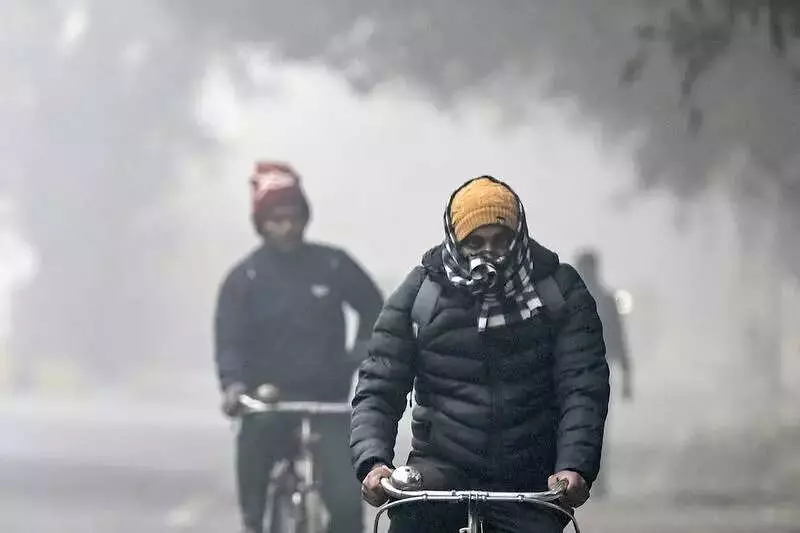
A new analysis for the year 2025 has confirmed Delhi's grim position as the most polluted city within the National Capital Region (NCR), with its toxic air posing a severe year-round health threat. The study by the Centre for Research on Energy and Clean Air (CREA) placed Ghaziabad and Noida next in line, highlighting a widespread air quality crisis across the region.
NCR Cities Breach Safety Standards, Data Gaps in Haryana
The report reveals a disturbing reality: Delhi's annual PM2.5 concentration stood at 96 micrograms per cubic metre. This is not only 2.4 times higher than India's own National Ambient Air Quality Standard (NAAQS) of 40 micrograms but a staggering 19.2 times above the World Health Organization's (WHO) annual safe guideline of 5 micrograms per cubic metre.
While Delhi saw a slight annual decline compared to 2024, the polluted season average from October to December actually increased. Alarmingly, PM2.5 readings at all 40 monitoring stations in the capital were at least 1.8 times the annual standard. The analysis also exposed significant monitoring gaps, with 15 cities in Haryana having insufficient data coverage for 2025.

Jahangirpuri Most Polluted, Local Sources Contribute 35%
Within Delhi, Jahangirpuri emerged as the most polluted monitoring station with an annual average PM2.5 level of 130 micrograms per cubic metre. It was followed by Wazirpur (124), Bawana (123), Anand Vihar (121), and Rohini (115). NSIT Dwarka recorded the lowest level at 73 micrograms, yet it still far exceeded safety limits.
A separate analysis by the Centre for Science and Environment (CSE) for the post-stubble burning period (December 1-15, 2025) provided crucial source insights. It found that only about 35% of Delhi's total PM2.5 originated from local sources within the city. The dominant 65% came from NCR districts and regions beyond Delhi's borders.
Of the local contribution, transport was the single largest sector, accounting for 46% of PM2.5. Industry contributed 22%, and household-level emissions made up 11%.
Year-Round Crisis Calls for Systemic Solutions
CREA analyst Manoj Kumar emphasized that pollution in the NCR is no longer a winter-only phenomenon but persists throughout the year. He stated this situation underscores the failure of short-term measures and stresses the urgent need for sector-specific, year-round emission reduction targets that also address significant transboundary pollution.
In a contrasting note, the Commission for Air Quality Management (CAQM) reported that the average Air Quality Index (AQI) for Delhi in 2025 was 201, the second lowest in seven years since 2018, slightly better than 2024's 209. The lowest AQI was recorded in the COVID-affected year 2020 at 185.
The report concludes that except for Bharatpur and Alwar in Rajasthan, all NCR cities breached the annual PM2.5 standard, with Ghaziabad experiencing the highest number of days exceeding the daily limit. Among India's megacities, Delhi continued to have the highest annual PM2.5, while levels in Kolkata and Mumbai remained stable, Bengaluru saw a marginal decline, and Chennai a slight increase.