

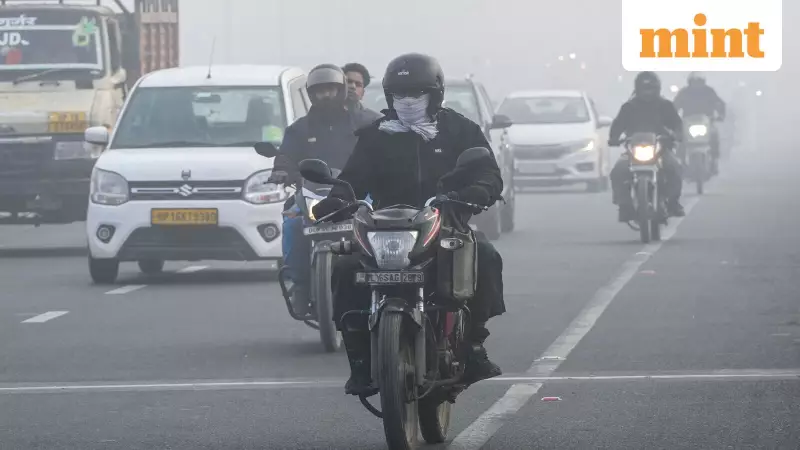
In a stringent move to combat the capital's deteriorating air quality, the Delhi government has announced that petrol pumps will now refuse to refuel vehicles lacking a valid Pollution Under Control (PUC) certificate. The directive, issued by Delhi Environment Minister Manjinder Singh Sirsa, comes into immediate effect.
Strict Vehicular Restrictions Under GRAP
Starting Thursday, vehicles entering petrol stations in Delhi must produce a valid PUC certificate to be eligible for fuel. This measure aims directly at curbing tailpipe emissions from polluting vehicles on the city's roads. Minister Sirsa further elaborated that during the severe stages of the Graded Response Action Plan (GRAP) – specifically stages 3 and 4 – two major categories of vehicles will be barred from entering the national capital.
These include all vehicles that do not meet the BS-VI emission standards and any vehicles registered outside Delhi. The enforcement will rely on a combination of automatic number plate recognition (ANPR) systems and physical checks at the city's borders. The minister urged citizens to comply and avoid arguments with officials if found non-compliant.

Additionally, when GRAP stage 4 is invoked, vehicles transporting construction materials will be completely prohibited from entering Delhi. Highlighting the government's data-driven approach, Sirsa noted that eight out of the last eleven months saw better air quality compared to the same period last year, with November's average AQI about 20 points lower.
Wide-Ranging Enforcement and Penalties
The crackdown extends far beyond vehicular pollution. The Delhi Pollution Control Committee (DPCC) and district teams are conducting extensive surveys of industrial units. Action has been initiated against 824 industrial units, with over 2,000 notices issued and penalties worth approximately ₹9.21 crore imposed for violations of pollution norms.
A major focus is also on diesel generator (DG) sets and commercial establishments. Around 3,200 DG sets have been verified for compliance with Commission for Air Quality Management (CAQM) norms, with non-compliant units facing closure and fines. Specifically, about 318 banquet halls in Delhi have been instructed to ensure their DG sets meet standards or face sealing.
To date, a staggering 8.66 lakh vehicles have been issued challans for not possessing a valid PUC certificate, a move the government says has significantly boosted compliance and public awareness.
Long-Term Structural Reforms and Initiatives
The government is pushing several long-term projects to tackle pollution permanently. A key focus is on eliminating the legacy waste mountains at Delhi's landfill sites. The daily waste processing capacity has been ramped up from 20,000 metric tonnes to nearly 35,000 metric tonnes per day, with a target to complete bio-mining by 2026. So far, about 45 acres out of 202 acres covered by garbage have been reclaimed, with plantation forests being developed on the freed land.
On the transport front, 3,427 electric buses are currently operational in Delhi, with plans to add 7,000 more by December 2026 to drastically cut emissions. To curb industrial pollution, 280 units have been equipped with Online Continuous Emission Monitoring Systems (OCEMS) for real-time tracking, with a warning of strict action, including closure, for units failing to install them.
In a novel initiative to prevent biomass burning, the government is distributing 3,500 electric heaters free of cost to security guards and night workers to deter them from burning wood or waste for warmth. Scientific guidance is being provided by a newly constituted high-level group of scientists, headed by a former central environment secretary, to refine pollution mitigation strategies.






