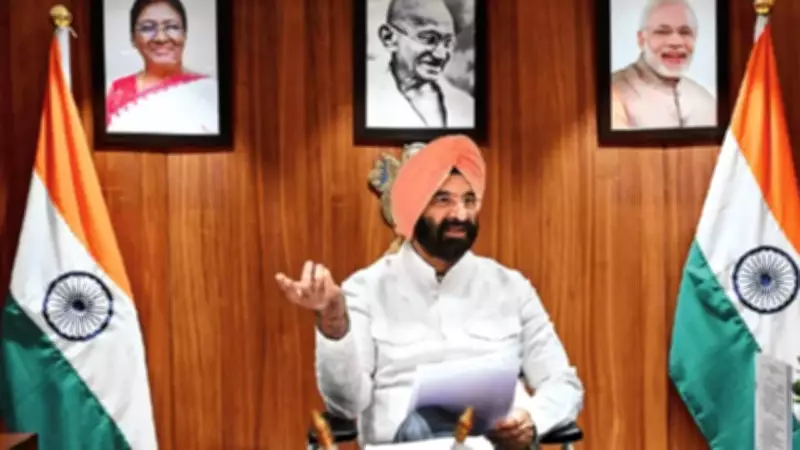
Delhi's Pollution Woes: A Year Under BJP Governance
In the first year since the Bharatiya Janata Party (BJP) assumed office in Delhi, pollution has emerged as the most persistent and critical challenge, with the capital recording its most polluted December air in six years. The Environment and Industries Minister has detailed the government's comprehensive strategy to help Delhi breathe easier, emphasizing a gradual approach over quick fixes.
Targets and Realistic Timelines
When asked about when Delhiites can expect air quality to meet national standards, the minister refrained from setting an exact deadline. "I cannot give an exact deadline because there are too many things to do," he stated. "But our target is to reduce pollution levels by 10-15% every year. This is not a task where you can simply turn on a regulator and see immediate results."
Drawing comparisons, he noted that China took nearly 11 years to lower pollution levels under the Beijing model, which involved relocating villages and industries and enforcing a shift to electric vehicles. However, he highlighted that such measures are not feasible for Delhi, given its dense population of over 30 million, massive waste generation, and heavy vehicular traffic. "We cannot relocate all JJ clusters, shut down all industries, or ask residents to give up their ICE vehicles," he explained, adding that even London required 45 years to achieve clean air.

Cloud Seeding and Innovative Solutions
Cloud seeding was announced as a key anti-pollution intervention, but initial trials proved unsuccessful. The minister confirmed that efforts are ongoing as a continuous process. "IIT Kanpur, with whom we have signed an MoU, is studying how to proceed and what studies need to be conducted," he said. "The work will continue as a study through different means, so that if required, it can be again presented as an emergency solution for Delhi. It is not a permanent solution."
To tackle pollution innovatively, the government has launched initiatives like an innovation challenge at IIT-Delhi, which has yielded ingenious solutions such as retrofits to trap emissions at exhausts and mounted air filters.
Criticism of Previous AAP Government
The minister sharply criticized the Aam Aadmi Party (AAP) government for its 11-year tenure, accusing it of inaction. "The AAP govt did nothing for 11 years," he asserted. "If you ask them what they did to control pollution, they will talk about the odd-even scheme and red light on, vehicles off campaign—both useless. Even the court questioned them."
He outlined what should have been done: end-to-end road carpeting to control dust, creating EV infrastructure, and introducing more e-buses. "Delhi's industrial areas have unpaved roads and no provision for sweeping. Major work that should have happened didn't. AAP just brought out advertisements. Now, after 11 years, we must work to fix their incompetence."
E-Waste and Industrial Regulation
A significant issue highlighted is the lack of e-waste management plants in Delhi, with e-waste often being burnt. "What a shame. Even Haryana has seven-eight plants," the minister remarked. The government has identified 27 non-conforming industrial areas where polluting industries operated without monitoring. Over 9,000 such industries have been brought under the Delhi Pollution Control Committee's checks, leading to the shutdown of more than 800 red-category units.
Additionally, the government has reclaimed 45 out of 202 acres from three landfill sites, reducing their height by a third, and is exploring uses for the reclaimed land, such as building a bus terminal at Bhalswa.
Data Transparency and Yamuna Revival
Concerns have been raised about missing air quality data on Diwali night and delays in releasing Yamuna water quality data. The minister defended the use of water sprinklers to settle dust, stating, "What can be more shameful than having water sprinklers but not using them to manage dust?" He acknowledged a maximum five-minute data gap on Diwali night and promised to review if it was longer. Regarding Yamuna reports, he said they are being uploaded regularly, blaming past administrations for the river's condition.

Despite record use of defoamers, frothing in the Yamuna persists. The minister admitted that challenges have lasted 25–30 years, with Delhi needing hundreds of sewage treatment plants instead of the current 35. "Untreated water is released into the Yamuna from Haryana... Work needs to be done at multiple levels. If things could be fixed with a magic wand in 365 days, AAP would have already done it. We will address it through slow and steady progress." On data discrepancies, he reserved comment until reviewing reports.
Reviving Water Bodies
When questioned about disappearing ponds and lakes in Delhi, the minister assured that the government is actively working on reviving them and removing encroachments, though specifics were not detailed.
As Delhi grapples with its pollution crisis, the BJP's plan focuses on incremental improvements, learning from global models, and addressing legacy issues left by previous administrations. The coming years will test whether this approach can indeed make Delhi a model for urban pollution management.