

Chinese Scientists Achieve Breakthrough in Desert Reclamation
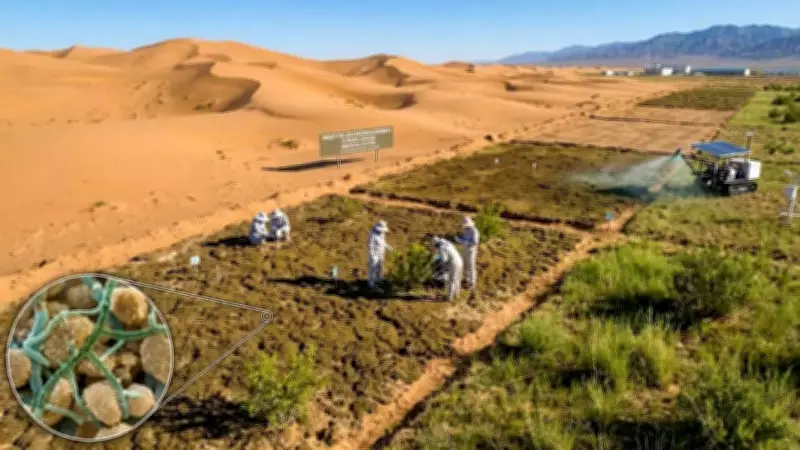
In a groundbreaking development, researchers at the Shapotou Desert Experimental Research Station in China have pioneered a revolutionary technique to reverse desertification. This innovative approach successfully converts barren, shifting sand dunes into productive, fertile land in an astonishingly short period of only 10 months. The method leverages cyanobacteria, specialized photosynthetic microorganisms, to create biological soil crusts that form a living, protective layer on the surface of unstable dunes.
How Cyanobacteria Transform Arid Landscapes
When these biological soil crusts are applied to sand, the cyanobacteria secrete glue-like substances based on sugars. These substances bind individual sand grains into a stable, solid mass, dramatically accelerating the natural soil formation process. This binding action not only stabilizes the desert floor but also rapidly increases essential nutrient levels, such as nitrogen and phosphorus. As a result, the crusts help retain moisture in the sand, creating a cost-effective and environmentally sustainable foundation for plant growth in extreme, dry environments worldwide.
Cyanobacteria are microorganisms that can be cultivated in laboratories and introduced to desert ecosystems to enhance their health. These resilient organisms thrive in extreme aridity, multiplying quickly when water is available. They form a crust that protects against wind erosion and provides vital nutrients, enabling shrubs and grasses to take root. This addresses the primary challenges of establishing vegetation in unstable, nutrient-poor deserts, offering a practical solution for ecological recovery.

Accelerating Recovery with Synthetic Crusts
According to a study published in Soil Biology and Biochemistry, Biological Soil Crusts (BSCs) are thin, living layers of soil formed from particles adhering to polysaccharide excretions of cyanobacteria. Research indicates that applying these microbial communities can accelerate organic carbon accumulation by 3.2 times and nitrogen accumulation by approximately 15 times compared to natural crust formation rates. By rapidly creating a stable 'sandbed' through chemical and physical processes, this method facilitates the establishment of more complex organisms, such as lichens and mosses, as noted in research on PMC-NIH.
Advantages Over Traditional Methods
Beyond initial stabilization, this technology offers a practical and low-maintenance alternative to traditional, labor-intensive desert reclamation methods like manual tree planting. The use of lab-grown, drought-resistant strains allows the technique to be adapted to various dry climates beyond China. Ongoing research into 'synthetic microbial communities,' as highlighted in PMC-NIH publications, supports the potential for optimizing specific bacterial strains to improve crust formation efficiency. This lays the groundwork for developing automated, large-scale desertification control systems globally, promising a sustainable future for arid regions.






