

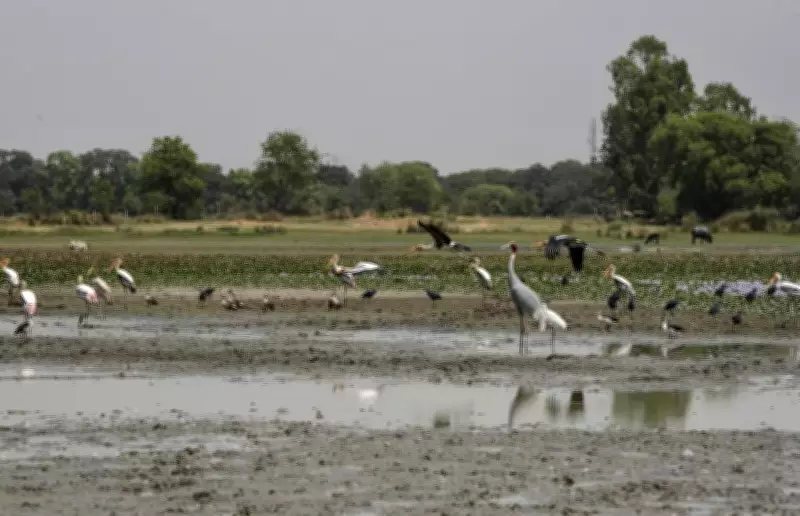
Dhanauri's Ramsar Tag Stuck in Bureaucratic Maze Despite Supreme Court Directives
Dhanauri in Greater Noida, a thriving habitat for nearly 217 bird species including Uttar Pradesh's state bird the sarus crane, fulfills at least two criteria to be declared a wetland of international importance under the Ramsar Convention. However, officially it remains unrecognized as a wetland, caught in years of bureaucratic delays despite clear judicial mandates.
Supreme Court Directives and Growing Wetland Count
In 2017, the Supreme Court in the MK Balakrishnan Vs Union of India case directed protection for all 2,01,503 wetlands mapped by the Union government under Rule 4 of the Wetlands (Conservation and Management) Rules, 2010. The court specifically prohibited activities like reclamation, conversion for non-wetland use, and any actions disturbing ecological character. By March 2024, ISRO's updated survey revealed this number had grown to 2,31,195 wetlands nationwide.
The Supreme Court expressed concern about delays in notifying updated Wetland Rules and lack of audited conservation spending, ordering the Centre to finalize and notify these rules by a fixed deadline. While wetland management responsibility shifted from the Union ministry to states in 2017 under new rules, the process for Ramsar designation involves a five-step procedure beginning with state government feasibility assessment.

Years of Delays and Contradictory Statements
In Dhanauri's case, the Union Ministry of Environment, Forest and Climate Change took the unusual first step on June 5, 2019—World Environment Day—writing to the Uttar Pradesh government to submit a proposal declaring Dhanauri both a large wetland and sarus crane sanctuary to initiate Ramsar tagging. Six years later, this still hasn't happened.
Environmentalists approached the National Green Tribunal in 2023 after years of demanding Ramsar status. Since then, contradictory statements and repeated adjournments have characterized the proceedings. During the first hearing in October 2023 following environmentalist Anand Arya's petition, state counsel claimed the notification proposal was submitted to the Wetland Authority on August 4, 2022, with additional documents provided on April 1, 2023.
Nearly 100 weeks later, in September 2025, UP's counsel sought another adjournment to determine if the state was ready to send a Ramsar proposal to the ministry and whether Yamuna Expressway Industrial Development Authority had objections. This despite NGT having already queried YEIDA, whose counsel in May 2025 promised action within three weeks.
Pattern of Promises Without Progress
The pattern extends back to September 2024, when UP counsel stated a Ramsar proposal had been prepared by the nodal officer but awaited forwarding by the principal chief conservator of forests. In January 2025, the state counsel submitted that the Wetland Authority had decided to declare Dhanauri a wetland, seeking four weeks to place the notification on record.
Environmentalist Anand Arya alleges bureaucratic preference for keeping Dhanauri as wasteland rather than wetland. "Once they declare it a wetland, the area has to be preserved and species conserved. But if they leave it as wasteland, they can gradually expand real estate for monetary returns," he explained.
Arya contrasted Dhanauri's years-long struggle with Noida International Airport in Jewar receiving "in-principle" approval on May 8, 2018 and environmental clearance by March 9, 2020. After his intervention during the Environment Impact Assessment, responsibility for conservation planning was assigned to Wildlife Institute of India.
Conservation Plans and Local Perspectives
The resulting conservation plan specifically addresses sarus cranes and peacocks, emphasizing water body preservation for wildlife habitats and public awareness initiatives. The EIA includes a special condition requiring Dhanauri conservation plan implementation before airport operations begin.

Local resident Umesh from Thasrana village describes limited livelihood opportunities due to perennial waterlogging on mostly private land. While unfamiliar with Ramsar specifics, he recognizes conservation importance for hundreds of bird species and potential tourism employment. College student Rohit celebrates the area as "a gift introducing us to nature's bounties," fascinated by diverse creatures while appreciating lotus-filled ponds.
Understanding Ramsar Convention Importance
The Ramsar Convention on Wetlands of International Importance, signed in Ramsar, Iran in 1971 and effective since 1975, represents a global treaty for wetland conservation and sustainable use. As of February 2024, over 2,500 Ramsar sites protecting more than 2.5 million square kilometers involve 171 national governments.
Ramsar designation supports global biodiversity conservation while providing multiple benefits:
- Enhancing national voice in international wetland forums
- Increasing site prestige and support
- Accessing updated conservation standards and guidelines
- Receiving expert management advice
- Fostering international cooperation
- Unlocking funding through grants and agency collaborations
Despite meeting criteria and judicial mandates, Dhanauri's Ramsar application remains trapped in bureaucratic limbo, highlighting challenges in balancing conservation with development pressures in rapidly urbanizing regions.





