

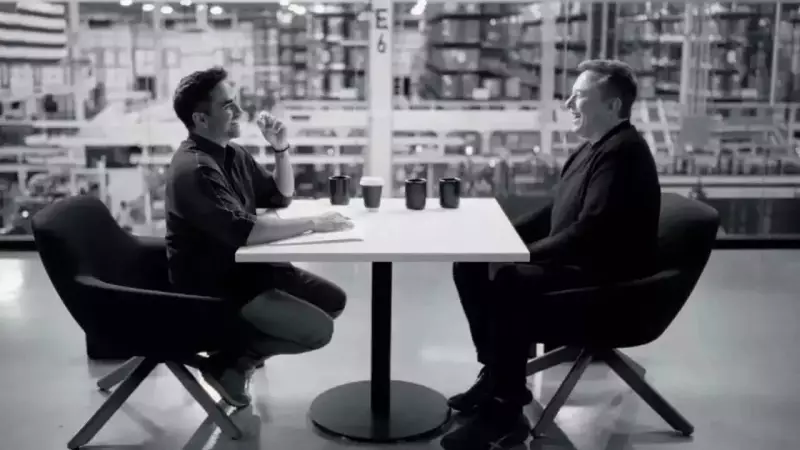
In a stark and thought-provoking discussion, tech billionaire Elon Musk has raised a red flag about one of humanity's most pressing yet under-discussed challenges: the global decline in fertility rates. Speaking with Nikhil Kamath, host of the podcast 'People by WTF', Musk outlined his grave concerns, suggesting that current demographic trends could lead to the eventual extinction of human civilisation if left unchecked.
Musk's Dire Warning: From Decline to Disappearance
Elon Musk did not mince words when describing the potential outcome of sustained population decline. He made a critical distinction between a simple reduction in numbers and a complete wipeout. "Well, I don't want humanity to disappear. But a 'decline' and 'disappear' are completely different things, right? Well, if the trend continues, we disappear," Musk stated emphatically. His argument goes beyond economics and taps into an existential crisis for our species.
For Musk, the issue is intrinsically linked to the growth of human consciousness and the advancement of civilisation itself. He posits that a larger population is fundamental to both. "Consciousness increases from a single-celled creature to a 30 trillion-celled creature. We are more conscious than bacteria. More humans mean more collective consciousness," he explained, using a biological analogy. In his view, fewer people directly translate to a diminished collective awareness, limiting humanity's ability to tackle profound questions and drive progress.

Parenthood: A Personal Choice with Civilisational Stakes
The conversation took a personal turn when Nikhil Kamath revealed he does not have children. Musk responded with a mix of lighthearted encouragement and serious conviction. "Maybe you should. You won't regret it," he advised Kamath. Musk passionately described parenthood as a transformative journey that allows adults to rediscover the world through a child's eyes, from infancy to the formation of complex ideas.
He framed the decision to have children not merely as a personal or lifestyle choice, but as a duty to the future of humanity. "We fundamentally have to have kids or grow extinct," Musk asserted, elevating the act of raising a family to a matter of species survival. He also touched upon the nature versus nurture debate, describing children as inheriting both genetic "hardware" and learned "software" from their parents, making the traditional dichotomy misleading.
Historical Context and Musk's Optimistic View of the Present
To underscore his point, Musk delved into history, contrasting today's realities with the brutal past. He noted that just a century ago, the average global life expectancy was a mere 35 to 40 years, with infant mortality being devastatingly high. Medical care was primitive, and threats like contaminated water were often fatal. "Maybe that is why people had so many kids. Without it, half the children would not survive," Musk reasoned, explaining the historical driver for large families.
Despite his alarming warning about the future, Musk expressed strong optimism about the present day. When asked how he would redesign the world's morality, politics, and economics, he countered that "The world is pretty great right now." He urged people to study history, pointing out that past centuries were marked by rampant disease, starvation, and tribal warfare, where a "good year" might have seen only 10% of a population survive.
The discussion concluded with a note on Musk's personal life. When Kamath pointed out that Musk himself has a large family, the entrepreneur joked, "Yeah, with multiple partners. Like an army. I am trying to get an entire Roman legion." This personal anecdote served to reinforce his core argument: that increasing the human population is vital for sustaining civilisation and propelling the expansion of human consciousness forward.






