

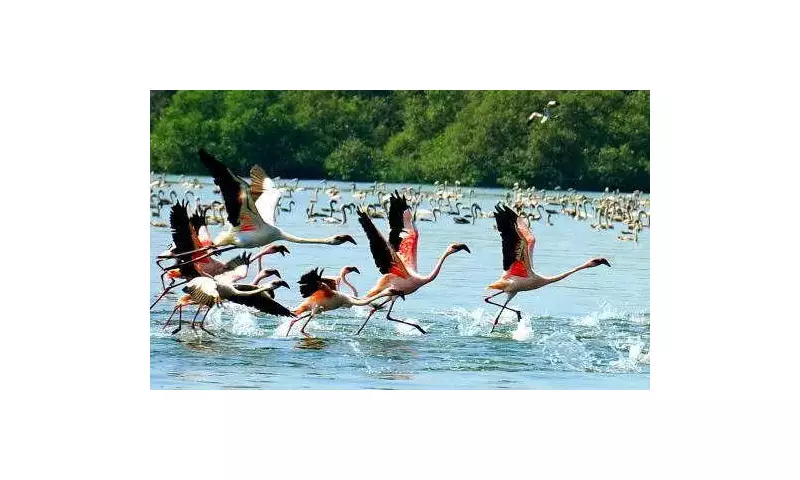
The much-awaited pink spectacle has officially begun along the Mumbai Metropolitan Region's coastline. The season's first flock of elegant flamingos has touched down in the wetlands of Mumbai and Navi Mumbai, sending a wave of excitement among bird watchers, environmentalists, and citizens alike. Their graceful arrival marks the informal commencement of the region's beloved annual 'pink season'.
A Slightly Delayed but Welcome Arrival
While their arrival was slightly delayed this year, attributed to the extended monsoon season, the sight of these long-legged waders sweeping over creeks and lakes has revived hopes for a robust migratory season. Senior bird researcher Mrugank Prabhu confirmed the initial count of around 300 greater flamingos in the Thane Creek area. Simultaneously, early flyovers were spotted by keen observers at the DPS Flamingo Lake in Nerul, Navi Mumbai.
Although the initial numbers are modest, authorities anticipate a significant increase soon. Prashant Bahadure, the Range Forest Officer at the Thane Creek Flamingo Sanctuary, confirmed that while current flocks are small, larger congregations are expected to arrive shortly. This annual migration transforms the mudflats into a vibrant sea of pink, creating a unique natural phenomenon for the urban region.

A Call for Urgent Wetland Protection
The return of the flamingos has amplified the persistent calls from conservationists to secure Mumbai's rapidly shrinking wetlands. B N Kumar, Director of the NatConnect Foundation, stated that the birds' arrival effectively marks the opening of 'Flamingo City's' pink festival. He used the occasion to urge the state government to finalise the long-pending Gazette notification to officially declare the DPS Lake in Nerul a Conservation Reserve. This proposal had already received approval from the State Wildlife Board back in April, following sustained campaigning by environmental groups supported by state forest minister Ganesh Naik.
Echoing the urgency, Sandeep Sareen of the Navi Mumbai Environmental Preservation Society appealed to citizens to wholeheartedly welcome these 'pink guests' while demanding stronger and more concrete protection for their critical habitats. Kumar specifically stressed the need to notify key wetlands without any further delay. The critical sites listed include Panje, Bhendkhal, and Belpada in Uran, along with NRI, TS Chanakya, and Lotus Lake in Navi Mumbai.
The National Context and Ecological Importance
These water bodies are part of a much larger ecological network. They are among the 24,000 wetlands mapped across Maharashtra under the ISRO-backed National Wetland Inventory and Assessment, prepared by the Space Application Centre in Ahmedabad. On a national scale, this inventory lists over two lakh wetlands larger than 2.25 hectares. However, formal notification and protection have lagged, often stuck in prolonged ground-truthing processes. A significant procedural hurdle was recently cleared when the verification conducted by the National Centre for Sustainable Coastal Management was completed.
Beyond their visual beauty, flamingos play a vital role in maintaining wetland health. They act as natural regulators by feeding on algae, plankton, and small invertebrates, which helps control nutrient levels and prevents harmful algal blooms. Their constant movement and feeding behaviour stir up the mudflats, improving aeration and benefiting aquatic plants and fish populations. Environmentalists emphasize that the presence of flamingos is a reliable bio-indicator of ecological stability. Their annual pilgrimage is not merely a seasonal spectacle but represents an essential partnership in keeping Mumbai's threatened mudflats and creeks ecologically alive and functional.
The arrival of the first flamingos is a powerful reminder of the delicate natural cycles that persist amidst urban sprawl. It underscores the immediate need for decisive action to protect these habitats, ensuring that the pink season continues to grace the shores of Mumbai for generations to come.






